
Union of Black Clergy and Laity
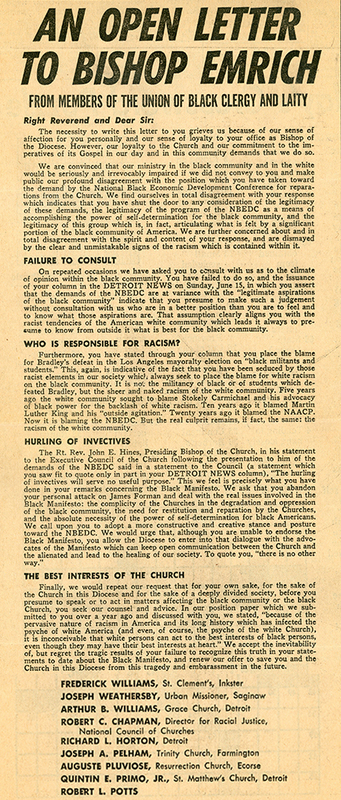
An open letter to Bishop Emrich from member of the Union of Black Clergy and Laity, undated.
In April 1967, a group of Black Episcopal priests published an open letter to Presiding Bishop Hines in The Episcopalian to protest discrimination in hiring, placement, and deployment of Black clergy. Despite the resolutions of General Convention and the number of qualified Black Episcopalians available, few Black clergy and laity had reached administrative positions at the diocesan or church-wide levels. Few Black professors had been hired at theological schools. And the Joint Urban Board of the Home Department, responsible for parishes and missions in the inner cities, had no Black members at all. A year later, in February 1968, seventeen Black priests, among the signatories of the letter, met at St. Philip’s Church in Harlem and established the Union of Black Clergy and Laity (UBCL) to fight for respect for Black Episcopalians and their full-participation in church governance.
The first UBCL annual conference, held at St. Augustine’s College in June 1968, brought together Black Episcopalians from across generations of activism, from the Conference of Church Workers Among Colored People to ESCRU, for community-building and planning. One such plan was a major protest that The Episcopal Church could not ignore. It came to fruition at General Convention II, the 1969 Special General Convention, when the UBCL introduced Muhammed Kenyatta to the floor.
Kenyatta’s presentation of the Black Manifesto to General Convention grabbed the headlines, but in the conversations on racism and reparations that followed, the UBCL took the opportunity to make demands of its own to the church: address racism in church hiring, include Black members on Executive Council, and include Black churches in General Convention Special Program (GCSP) decision-making. In response, General Convention II appointed a committee to study racism in the hiring process and a second one increasing representation in Executive Council. The 1970 General Convention adopted its proposed change to Canon 4 to increase Executive Council representation. Additionally, the GCSP hired a Black staff member to liaise with Black churches regarding the program’s grants. The UBCL had demonstrated its ability to drive change within the church.
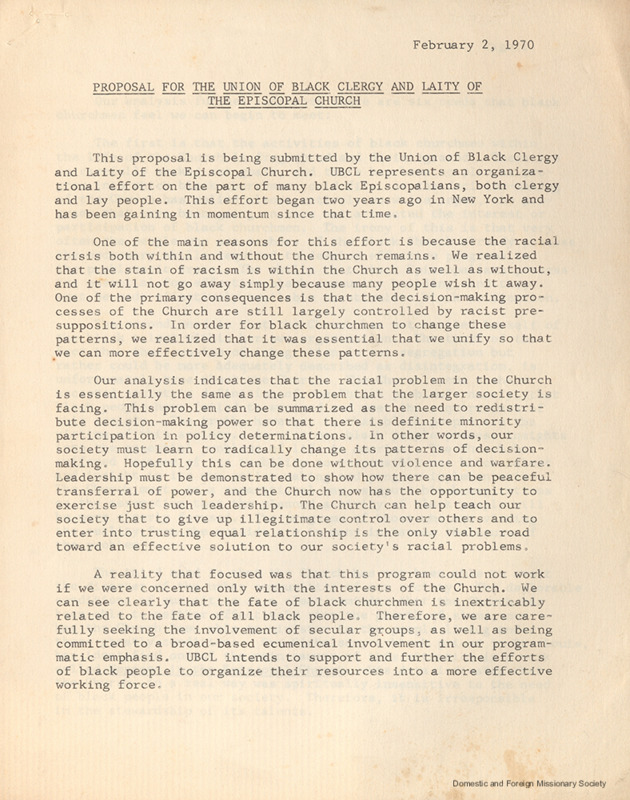
Proposal submitted by the Union of Black Clergy and Laity calling for the redistribution of decision-making power in the church, 1970. Read the minutes of the first meeting of the Board of Directors of the UBCL.
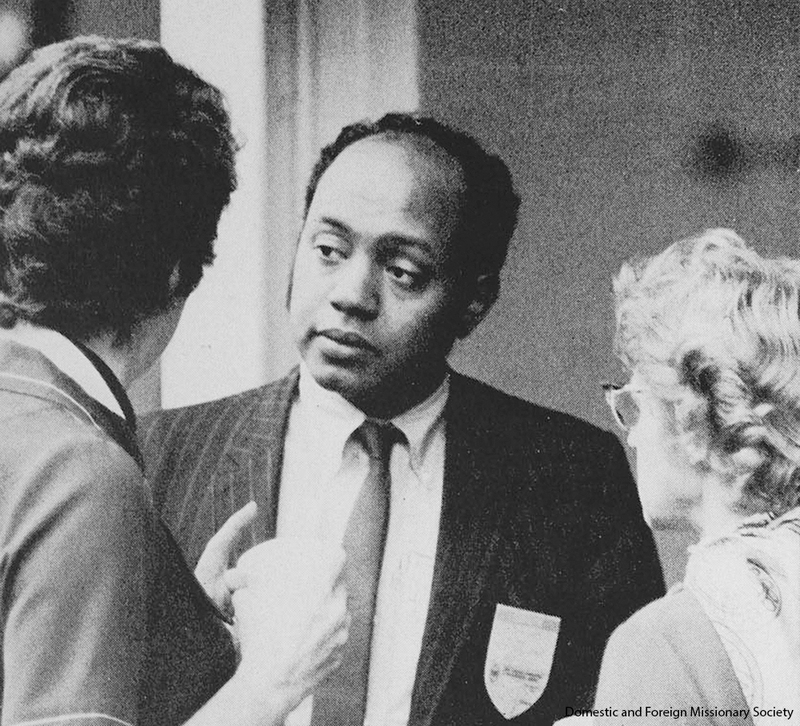
Union of Black Clergy and Laity president Frederick Williams, speaks with individuals during the 1970 General Convention held in Houston, TX.