
Socially Responsible Investing
In June of 1966, the Executive Council of The Episcopal Church adopted a resolution calling on all church institutions to reconsider their investment policies relating to South Africa. The church was prompted to re-examine its investment policies by an organization called the Episcopal Churchmen for South Africa (later renamed the Episcopal Churchpeople for a Free Southern Africa). Created by layman William Overton Johnston in 1956 as a ministry to liberate South Africa from apartheid, it challenged the complicity of the church towards white-dominated South Africa.
Executive Council began passing resolutions in 1968 narrowing the criteria for investments in companies and banks doing business in the region, and appointed an ad hoc committee in 1969 to examine the feasibility of utilizing ethical criteria to drive investments in companies doing business there. In 1970, the General Convention created a more permanent group to examine and address the church’s concerns that their investments be aligned with their moral obligations as a religious institution. The newly formed Executive Council Committee on Social Criteria for Investments, broadened the initial debate about investing in South African companies to consider the ethical implications of corporate investments in any country whose politics and structure were governed based on color.
In May 1971, armed with the updated criteria for investing, Rev. Joseph A. Pelham, ESCRU’s former national director, attended the shareholders meeting of General Motor Corporation to request that the company consider the adoption of equal employment policies at General Motor’s South African plants or the withdrawal from investments in that country. Presiding Bishop John Hines also spoke at the shareholders meeting stating that General Motor’s presence in South Africa was “increasing the strength and control of the racist dictatorship,” and called for the company to support their previously stated opposition to apartheid by changing their employment practices. These appeals, by both Hines and Pelham, marked the first time that a religious organization raised such a concern as shareholders in a corporation. While the measures requested by The Episcopal Church were ultimately defeated by the General Motors Company shareholders, the controversial actions of The Episcopal Church substantially influenced denominations and institutions nation-wide to reexamine their investment policies.
In 2008, the Executive Council Committee on Social Criteria for Investments became the Executive Council Committee on Corporate Social Responsibility.
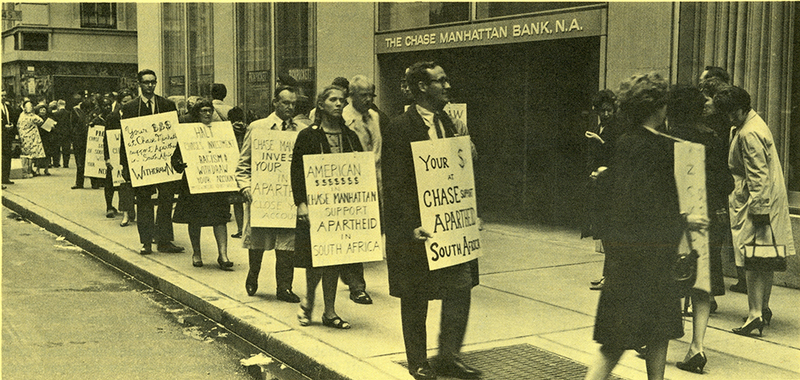
A demonstration, sponsored by the Committee of Conscience Against Apartheid, held in front of Chase Manhattan Bank as part of the continuing campaign for withdrawal of accounts due to Chase’s direct financial support to the government of South Africa, 1966.
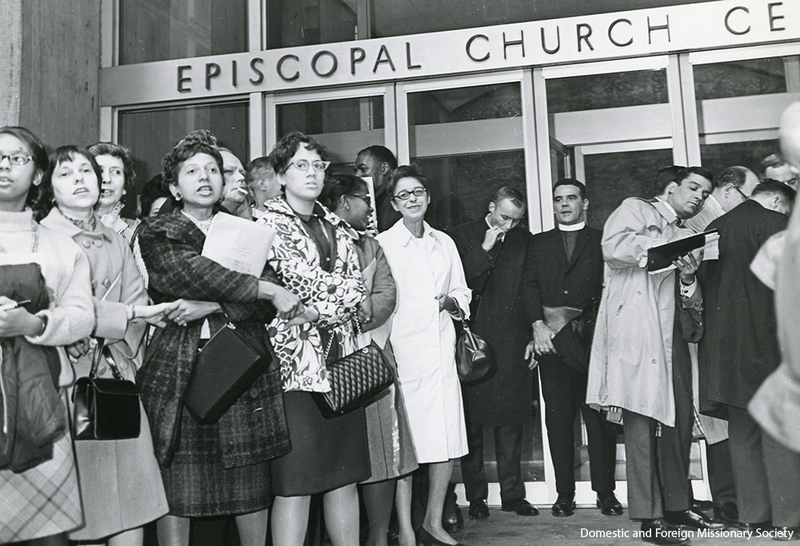
ESCRU protesters holding hands in front of the Episcopal Church Center, 1966.