
The Most Reverend John Hines, 1910-1997
Against even the worst of possibilities, must be set the inescapable obligation of Christians, that the Body of Christ must be prepared to offer itself up for the sake of the healing and the solidarity of the whole human family, whatever its religious or racial identities. Especially must the Body of Christ risk its own life in bearing and sharing the burdens of those who are being exploited, humiliated, and disinherited!
- John Hines
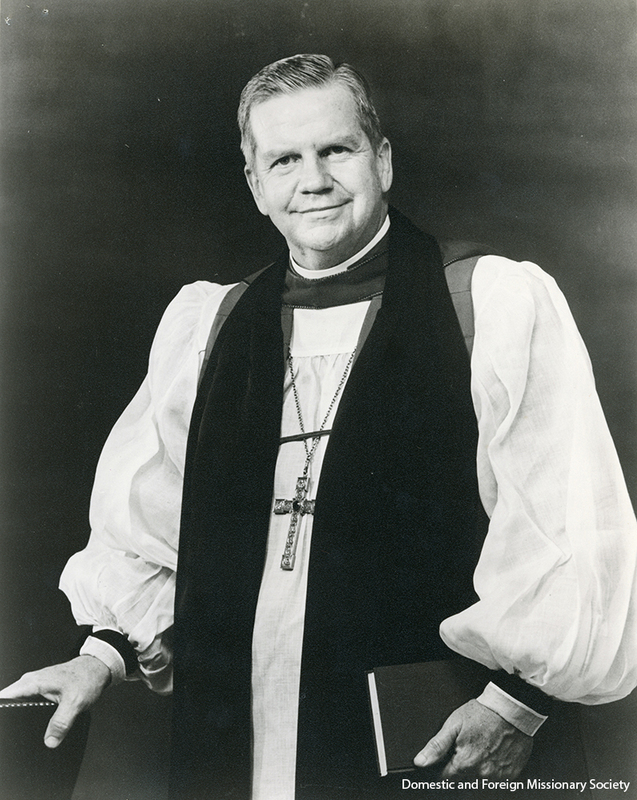
As Presiding Bishop of The Episcopal Church, the Rt. Rev. John Hines focused on social justice through the empowerment of community groups, undated.
Born October 3, 1910, John Hines grew up in the rural South Carolina community of Seneca where he attended a small Episcopal church. After completing his studies at the University of the South, Hines graduated from the Virginia Theological Seminary, starting his ordained ministry during the Great Depression in 1933. Hines was called first to serve in St. Louis, Missouri, under the direction of Bishop William Scarlett, a prominent advocate of the Social Gospel, which emphasized the active application of Christian principles to solving society's problems. There he met and married Helen Orwig with whom he would raise four sons and a daughter.
Called to serve a large parish in Augusta, Georgia in 1937, Hines continued to spread the message of Christian social action that he learned under Bishop Scarlett. While in the deep South, he was a courageous preacher against the sin of discrimination and defended those lacking sufficient educational, economic, political, and social resources. During World War II, Hines served as rector of Christ Church in Houston, Texas. In 1945, at the young age of thirty-four, he was elected Bishop Coadjutor of the Diocese of Texas, a position he held for a decade. Hines’ ecclesiastical building achievements proved to be unparalleled. He established a seminary, a secondary school, a nursing home, and forty-one new congregations during his term. After his consecration as Bishop of the Diocese of Texas in 1955, he worked to integrate all the institutions and agencies of his diocese and urged advocacy for civil rights by Episcopalians.
The House of Bishops recognized Hines’ drive, commitment, and character when they elected him as Presiding Bishop in 1965, a turbulent time within the country and The Episcopal Church. Hines guided the church, labeling himself a “theological conservative and social progressive.” Taking an activist approach to social issues, Hines supported greater minority involvement in church councils and the ordination of women.
Above all, Hines positioned himself on the battlefront where Christian values converged with racism and poverty. This was profoundly evident in his response to the riots that broke out in dozens of American inner cities in 1967. Hines boldly proposed a reordering of the church’s financial priorities in order to help address the deep inequalities in American society. He proposed empowerment and self-determination for Black Americans by advocating for political and economic independence based on financial help free of conditions.
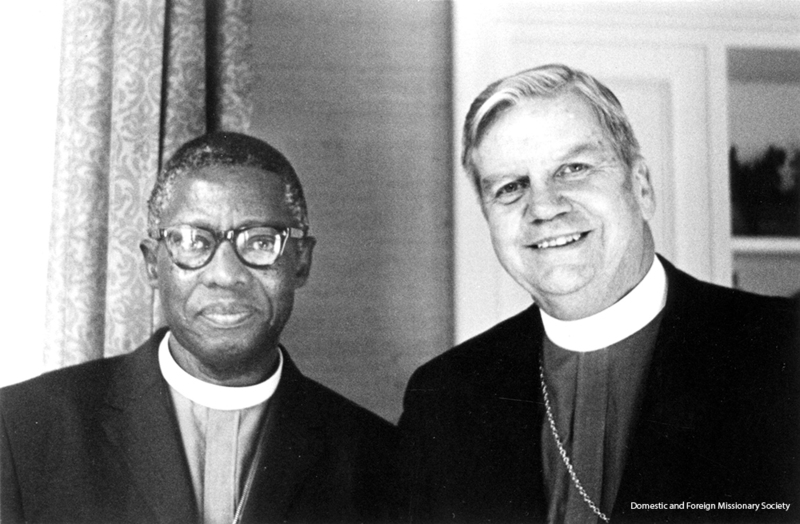
The Rt. Rev. John Hines (right), Presiding Bishop of the Episcopal Church, with the Rt. Rev. Alphaeus H. Zulu (left), Bishop of Zululand in South Africa, during his visit to the United States, 1971.
His vision resulted in the General Convention Special Program. Initially accepted by church members, it later became a source of dissension and caused many congregations to withhold funds from the General Convention. Despite the backlash and misgivings of the Episcopalian majority, the GCSP was a positive step towards addressing overt racism in the church.
Hines demonstrated his innovative approach once again in 1971 when, at a General Motors shareholders’ meeting, he supported divesting American corporations of interests in South Africa as a way of protesting the systematic racism of apartheid. The divestment movement was credited by former Archbishop Desmond Tutu of South Africa as fundamental in the eventual collapse of apartheid. In 1971, Hines was named “Clergyman of the Year” by the interfaith organization Religious Heritage of America.
As a result of controversy and criticism during his tenure, Hines voluntarily retired before the end of his term as Presiding Bishop. Although he forever changed the church’s definition of domestic mission to social engagement, his positions contributed to the church’s shrinking population and members’ loss of confidence in national church structures. His experience also had a profound personal toll. From his retirement in 1974 until his death, Hines rarely participated in national church affairs, preached infrequently, lectured occasionally, and joined in the consecration of bishops.
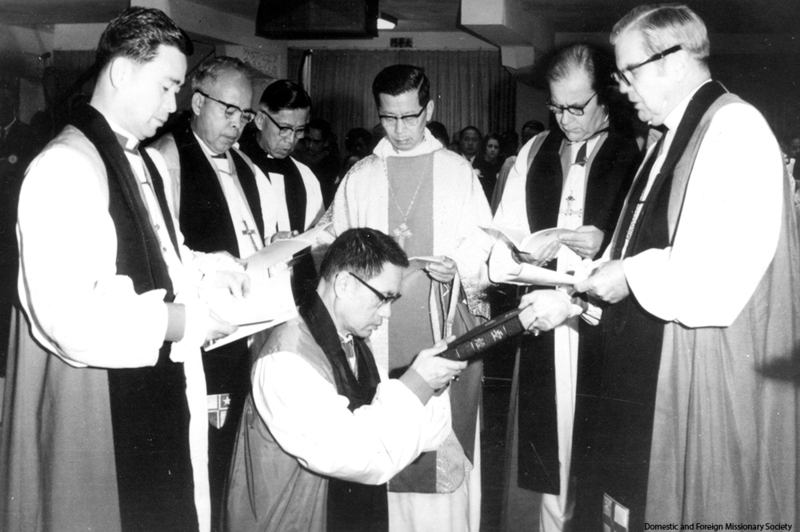
The Rt. Rev. John E. Hines presents a Bible to the Rt. Rev. James Te-Ming Pong at his consecration as Bishop of the Missionary Diocese of Taiwan on January 6, 1971.
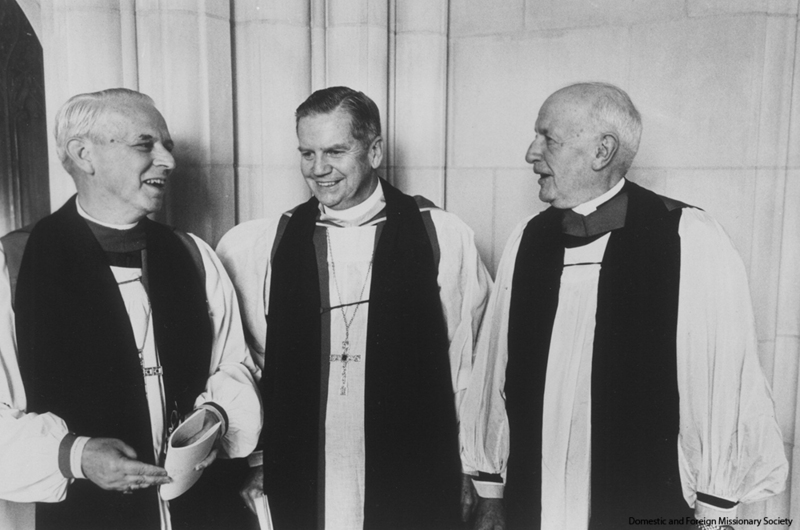
Bishop Hines visits with former Presiding Bishops Lichtenberger and Henry Knox Sherrill before his installation, 1965.