
John Maury Allin
“Bishop Hines I think really broke the ice. He was the pioneer and maverick in many ways. He was kind of like Roosevelt...alienated his blue-blood background by taking on the causes of minorities and poor people...I think Hines may have been seen in the same way, betraying the carriage trade image of the Episcopal Church and actually getting his hands dirty and involving himself with minorities and poor people in inner cities. Allin picked up the baton...he was even more concerned about ... doing the right thing.”
-Harold Lewis
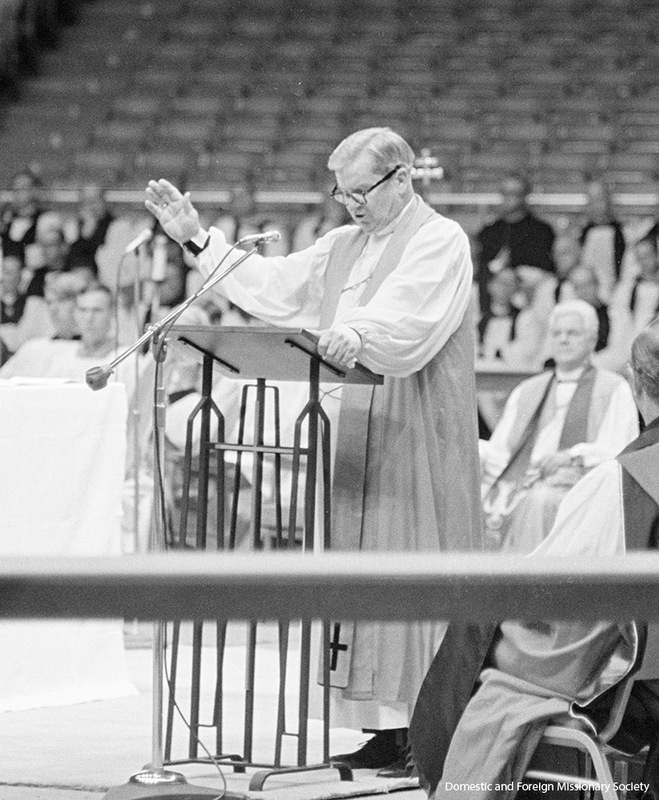
Presiding Bishop John E. Hines speaking at the Special General Convention, 1969.
Bishop Allin was elected as the twenty-third Presiding Bishop of The Episcopal Church in 1973. His tenure commenced at a time of considerable turbulence in the church that began with the episcopate of Presiding Bishop John Hines in 1965. Hines was a social progressive whose advocacy of civil and women's rights and opposition to the Vietnam War caused institutional tremors with far reaching consequences for the relationship between General Convention and the diocesan and parochial jurisdictions of the church. Chosen as a steadying force for the church, Allin faced the tumultuous 1970s with a talent for compromise and a resolve to promote reconciliation. While Bishop of Mississippi, he had helped to found the Committee of Concern, an ecumenical and civic alliance organized to raise funds to rebuild over 100 Black congregation churches that had been burned by white racist groups.
Perceived as a traditionalist within a liberal church, John Allin continued to push for the church to address issues of social justice. His offer to resign after the General Convention voted in 1976 to permit the ordination of women, an issue on which Allin was firmly opposed, was answered with a House of Bishops resolution that respected his, “right to hold a personal conviction on this issue” and that of any church member who opposed women's ordination. Allin stayed on, overseeing yet another major change within the church during his term with the 1979 adoption of a new edition of the Book of Common Prayer for standard use.
Bishop Allin seized the opportunity to channel the church’s restless energy into a common mission enterprise even in the face of these divisive issues. He single handedly persuaded a reluctant Executive Council to launch a national fund raising initiative in support of programs to alleviate poverty and injustice, clergy education, and congregational development. “Venture in Mission” (VIM) was a major fundraising success that greatly expanded social justice programs and ministry during the 1970s. VIM was a tremendous success in the local dioceses, far outreaching its $100 million goal and funding hundreds of still-active Church programs and community non-profits.
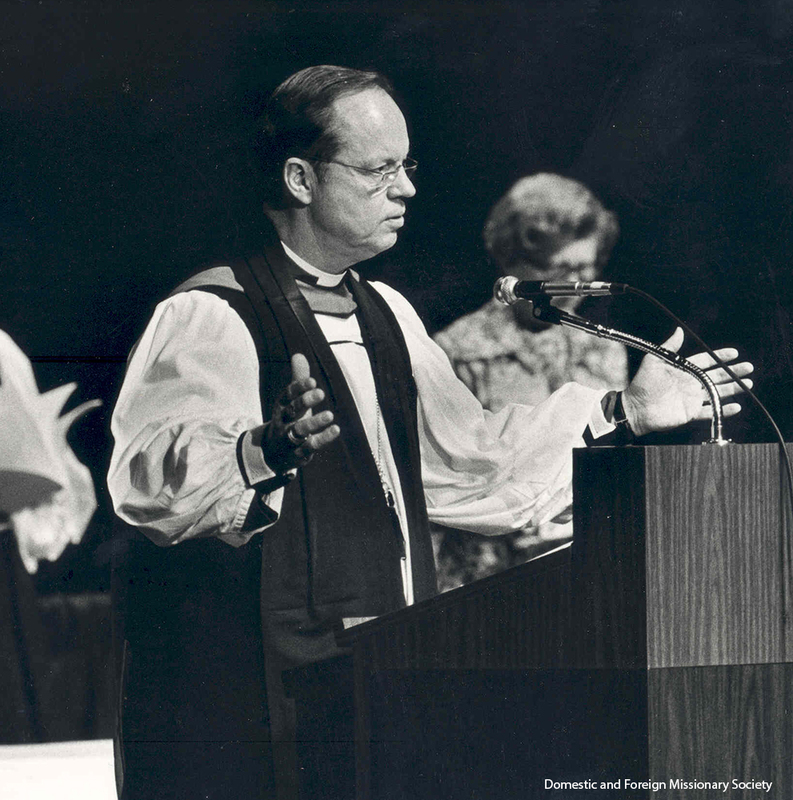
Presiding Bishop John Allin speaking at the 1976 General Convention, which voted to allow the ordination of women in The Episcopal Church.
Allin was perceived to be more concerned with enabling leadership within the church’s Black clergy than seeking the advice of outside experts. The last officer in charge of African American affairs at The Episcopal Church headquarters, the Reverend Tollie Caution, had been summarily pushed aside by the Hines administration as a man out of step with the new order. Under Bishop Allin the Office of Black Ministries was established. In addition, he ensured more secure funding for the three Episcopal historic Black colleges: St. Augustine’s, St. Paul’s, and Voorhees. He restored a Black ministries priest on his staff, and initiated affirmative-action hiring. During his term, Dr. Charles Radford Lawrence was elected President of the House of Deputies, the first African American to hold that post. Lawrence used his appointment power to introduce greater numbers of African Americans and other under-represented groups to the church’s decision making bodies.