
The Most Reverend John Maury Allin, 1921-1998
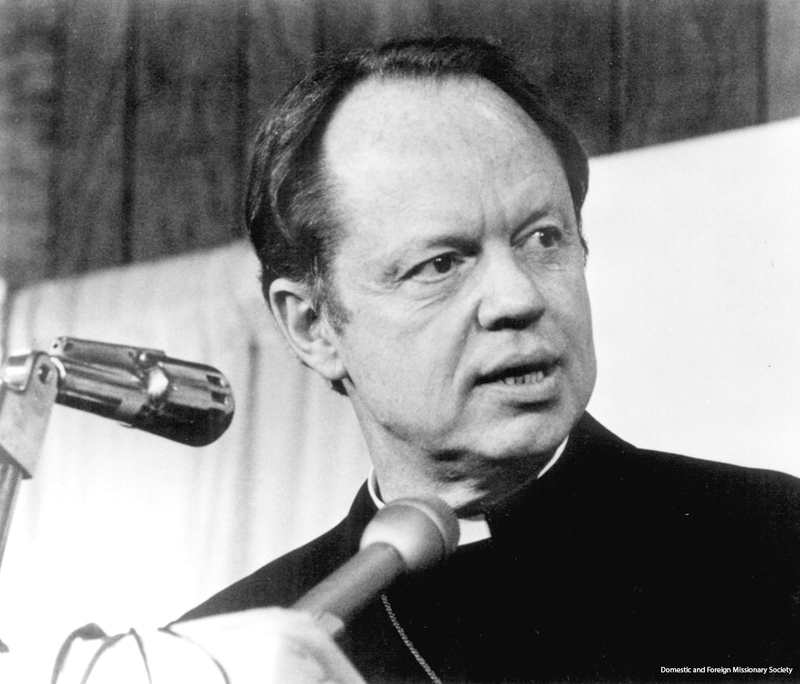
Presiding Bishop-elect John Maury Allin at his first press conference, General Convention, 1973.
Born April 22, 1921 in Helena, Arkansas, John Maury Allin attended college and seminary at the University of the South, Sewanee, Tennessee and graduated with a Bachelor of Arts in History in 1943 and a Master of Divinity in 1945. He was ordained to the diaconate in 1944 and to the priesthood in 1945, both in the Diocese of Arkansas. His first pastoral assignment was at St. Peter's Episcopal Mission in Conway, Arkansas where he also taught psychology at Arkansas State Teachers College. In 1949, Allin married Frances Ann Kelly, also of Helena, Arkansas, with whom he raised a son and three daughters. He spent the next eight years in Louisiana, first in New Orleans in several roles:curate of St. Andrew's Church, chaplain to Episcopal college students, and Institutional Chaplain of New Orleans. He began a term as rector of Grace Episcopal Church in Monroe, Louisiana in 1952. In 1958, Allin agreed to serve as president and headmaster of All Saints School, Vicksburg, Mississippi. In 1961, the Diocese of Mississippi elected Allin as Bishop Coadjutor, a position he held until his consecration as the Sixth Bishop of Mississippi in 1966. During this time he also earned two additional advanced degrees, a Master of Education and Doctor of Divinity.
Bishop Allin was elected the twenty-third Presiding Bishop of The Episcopal Church in 1973. His tenure commenced at a time of considerable turbulence and change that began in 1965, during the episcopate of Presiding Bishop John Hines. Hines was a social progressive whose advocacy for civil and women's rights and opposition to the Vietnam War disrupted the relationship between General Convention and the diocesan and parochial jurisdictions of the church. Chosen as a steadying force for the church, Allin faced the tumultuous 1970s with a talent for compromise and a resolve to promote reconciliation.
Perceived as a traditionalist within a liberal church, Allin offered to resign after the General Convention voted in 1976 to permit the ordination of women, an issue Allin was firmly opposed. The House of Bishops answered with a resolution that respected his "right to hold a personal conviction on this issue" and that of any church member who opposed women's ordination. Allin stayed on, overseeing yet another major change within the church during his term with the 1979 adoption of a new edition of the Book of Common Prayer for standard use. He also founded new local and national mission initiatives including Venture in Mission, a major fundraising effort that greatly expanded social justice programs and ministry during the 1970s and a tremendous success in the local dioceses, far outreaching its $100 million goal.
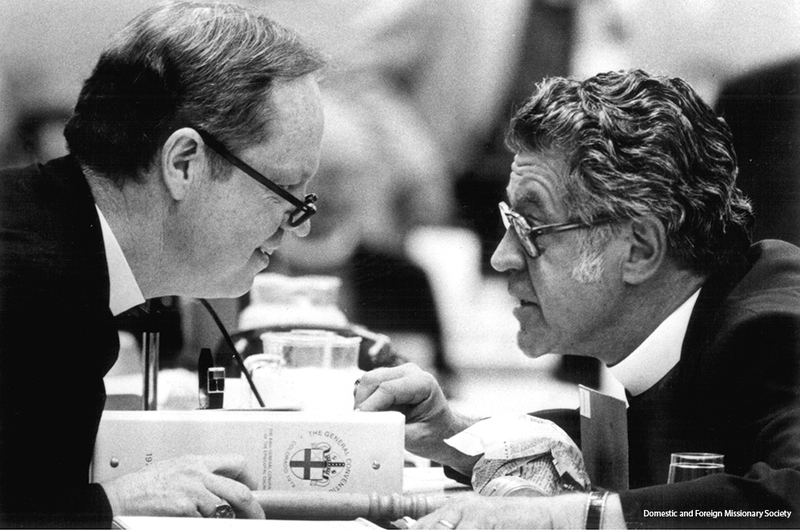
Presiding Bishop John Allin (left) at the 1979 General Convention with Rt. Reverend Lloyd E. Gressle of Bethlehem.
Under Bishop Allin, the Office of Black Ministries was established at The Episcopal Church headquarters. In addition, he ensured more secure funding for the three Episcopal historic black colleges: St. Augustine’s, St. Paul’s, and Voorhees. He restored a Black Ministries priest to his staff and initiated affirmative-action hiring as well. During his term, Dr. Charles Radford Lawrence was elected President of the House of Deputies, the first African American to hold that position. Lawrence used his appointment power to increase representation of minority groups to the church’s decision making bodies.
Allin retired as Presiding Bishop in 1985. He remained active in the church as "winter" chaplain at Christ Memorial Chapel on Jupiter Island, Florida and during the summer as vicar of St. Ann's Church, in Kennebunkport, Maine. Allin's ties to his alma mater remained strong throughout his life. From 1961 onward he served as a Trustee of the University of the South, served two six-year terms as one of its Regents, and was its 17th chancellor from 1973-1979.
Allin was diagnosed with lung cancer in late 1997 and died on March 6, 1998 in Jackson, Mississippi of complications from a stroke suffered the month before. Memorial services were held at the Cathedral Church of St. Andrew in Jackson on March 9 and on March 14 at All Saints Chapel in Sewanee, Tennessee, where he was buried.