
Charles Vert Willie, 1927-2022
As blacks refused to participate in their own oppression by going to the back of the bus
in 1955 in Montgomery, women are refusing to cooperate in their own oppression by remaining
on the periphery of full participation in the Church in 1974 in Philadelphia.
- Charles Willie
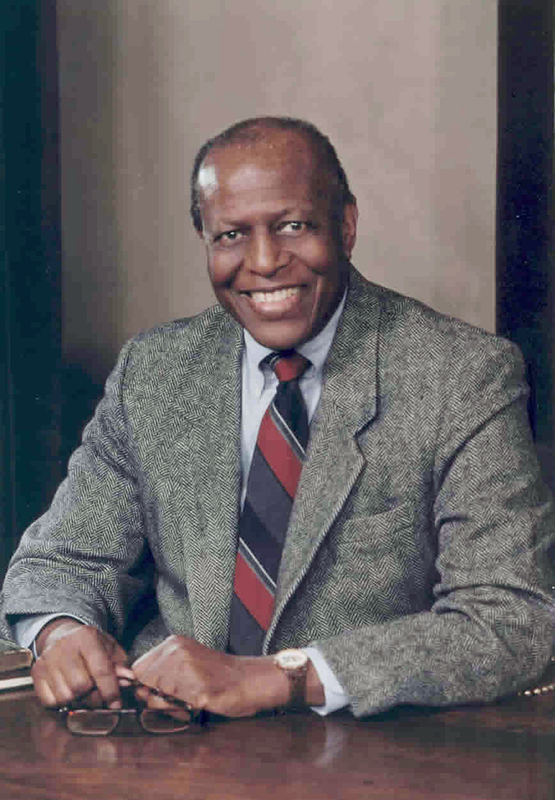
Charles V. Willie, sociologist and Charles William Eliot Professor of Education, Emeritus, Harvard University, undated. Photo courtesy of Charles Willie.
Charles Vert Willie was born in Dallas, Texas on October 8, 1927, a grandson of enslaved people. He attended Morehouse College, studying in the same sociology program as Martin Luther King, Jr., and graduated with his Bachelor’s degree in 1948. He then earned a Master’s degree from Atlanta University (1949) and a Ph.D. in sociology from Syracuse University (1957).
Willie began teaching sociology at Syracuse University as a graduate student lecturer in 1950. Over his twenty-four year career with the university, he became its first Black tenured faculty member; chaired the Department of Sociology; and served as Vice President of Student Affairs. In 1974, Willie left Syracuse for Harvard University, where he became a professor of education and urban studies and later the Charles William Eliot Professor of Education at the Graduate School of Education. In addition to his academic work, Willie served as a consultant, expert witness, and court appointed master in major school desegregation cases across the nation. President Jimmy Carter appointed him to the President’s Commission on Mental Health in 1977.
Within The Episcopal Church, Willie was elected to the Executive Council (1968) and twice as Vice President of the House of Deputies (1970 and 1973), making him the first Black Vice President elected by the deputies. However, he resigned from both positions in 1974 to protest the treatment of the Philadelphia 11, the first women priests ordained in The Episcopal Church. Willie, who preached a sermon at the ordination on July 29, 1974, said of House of Bishops’ preoccupation with whether or the not the ordination was valid, “In the Christian religion, concern for personhood always takes precedence over concern for procedures.”
Willie held honorary degrees from Berkeley Divinity School, Episcopal General Seminary, and Seabury-Western Theological Seminary, as well as the Episcopal Divinity School for distinguished and faithful ministries in social justice. He authored or edited more than twenty-five books and articles addressing issues such as women’s rights, community development, race relations, and urban education.
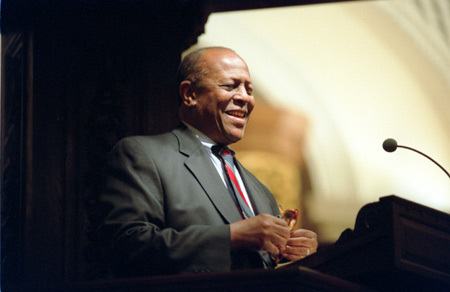
Charles V. Willie remembers Martin Luther King, Jr. during a special service at the Memorial Church at Harvard University, 2002. Photo courtesy of Harvard University.
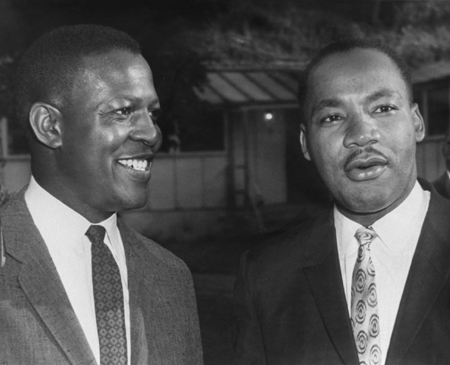
Charles V. Willie (left) prepares to introduce Martin Luther King Jr. at a rally at Syracuse University in the 1960s. The two men first met when both were teen-age students at Morehouse College. Photo courtesy of Harvard University.
LISTEN
Dr. Charles Willie, Professor of Sociology, explores the problem of growing urban diversity coupled with increasing neighborhood segregation, and discusses the interdependence of the races, 1969.