
William Stringfellow, 1928-1985
The central witness of the Church in the racial crisis is to bear the rejection of white people by Negroes, provoked by three centuries of exclusion and exploitation of Negroes by whites, and to bear this terrible, compounding hostility between the races without protest or complaint, without concern for innocence or guilt (that is for God’s judgment and forgiveness to reveal), in other words, in the love of Christ for the whole world.
- William Stringfellow, My People Is the Enemy, 1964
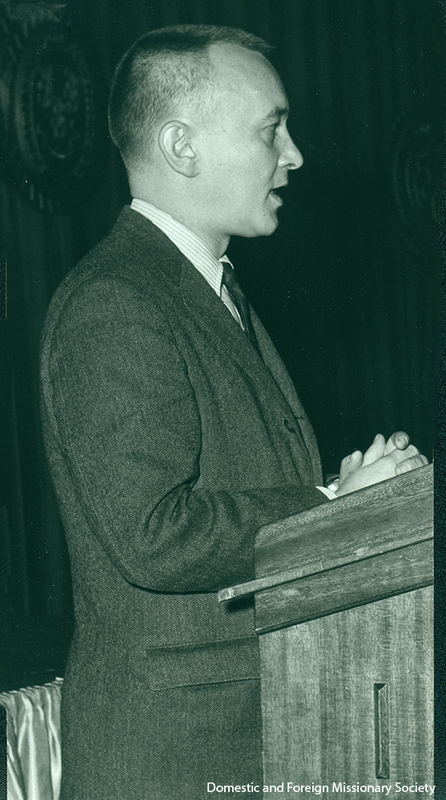
William Stringfellow speaks at the third annual meeting of ESCRU, December 8, 1963.
William Stringfellow was born to a working class family in Rhode Island in 1928, and grew up in Massachusetts. He attended Bates College in Lewiston, Maine and received a scholarship to study at the London School of Economics. After serving in the U.S. 2nd Armored Division of the United States Army, he finished his education at Harvard Law School. Upon graduation in 1956, he moved to a small apartment in Harlem, New York and began a law practice representing his low-income Black and Hispanic neighbors. During this time, he became a founding member of the Episcopal Society of Cultural and Racial Unity (ESCRU).
In Harlem, Stringfellow witnessed first hand the effects of poverty, which he documented in his 1964 "autobiographical polemic," My People is the Enemy, which Rev. M. Moran Weston, rector of St. Philip’s Church in Harlem, criticized as an oversimplified portrayal of the Black experience as universally negative. Stringfellow advocated for addressing racism in its insidious forms. He argued that the impact of the “platitudes of tolerance” in Northern cities, when compared with the reality of the indifference, hostility, and condescension with which Black people were actually treated, was psychologically more damaging to those who endured it than was the open segregation of the South. He concluded that “the decisive front in the racial crisis in America is the urban North, and not the South.”
Socially and politically, Stringfellow often found himself aligned with the more liberal sectors of the church and of society. In addition to his regular legal practice, he defended the arrested members of the ESCRU “Prayer Pilgrimage” and the first women to be irregularly ordained to the priesthood; he harbored Catholic anti-war activist Daniel Berrigan, who was wanted by the FBI for burning draft cards; he defended Bishop James Pike against heresy charges; and he was a vocal critic of homophobia. However, he often differed theologically with social liberals and insisted unwaveringly that the Bible should be the sole arbiter of a Christian conscience.