
St. John’s Hospital
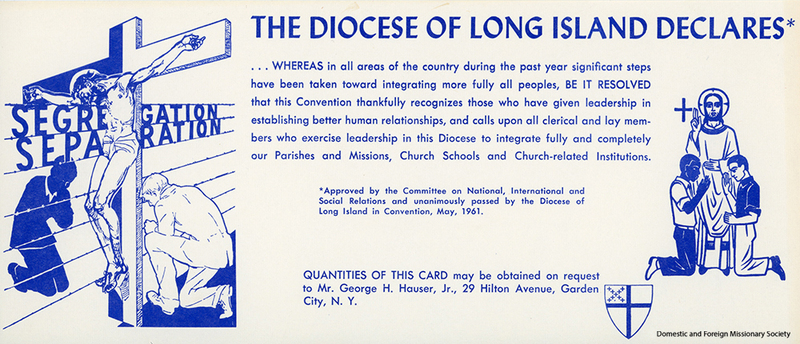
Card distributed in 1962 by the Long Island chapter of ESCRU to heighten awareness of St. John’s Hospital segregationist practice.
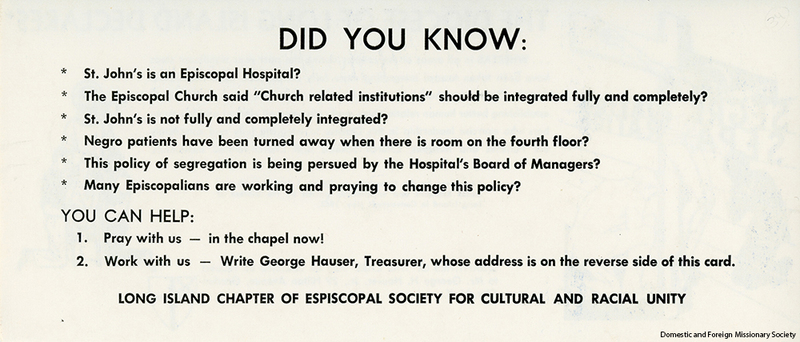
Back of card.
St. John’s Hospital in Brooklyn, New York, an Episcopal institution of the Diocese of Long Island, was the focus of action by the Long Island chapter of ESCRU in 1962. After receiving complaints that the hospital excluded Black patients from private rooms and segregated them into semi-private ones, ESCRU alerted Bishop James P. DeWolfe of the Diocese of Long Island who was president of the hospital’s board of managers. Bishop DeWolfe appointed a special commission to investigate the charges, which found that “some segregation results” from the hospital’s policies. The bishop defended the hospital’s policies, however, arguing for a “principle of consent,” which would allow members of the same race to be housed in the same rooms. ESCRU viewed the hospital's continuance of institutional racism under a guise of personal conscience as an unacceptable retreat from the marginal progress African Americans had made in turning the church toward a path of justice.
In response, ESCRU organized a vigil outside St. John’s Hospital in early July 1962 that was attended by 150 people and included representatives from local chapters of the Congress on Racial Equality and the National Association for the Advancement of Colored People (NAACP). The accompanying publicity led the City Commission on Human Rights to launch an investigation and to ask the Presiding Bishop to intervene. Faced with another planned protest at the hospital and the diocesan offices on July 11, Bishop DeWolfe directed the hospital to amend its policies and finally offered to meet with the diocesan clergy to open up what was now a much broader discussion of exclusion and race.
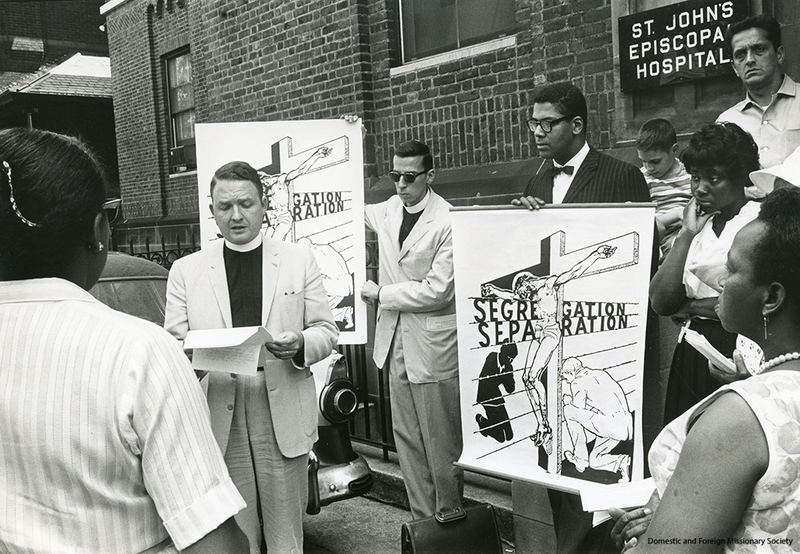
John Morris and other ESCRU members protesting outside of St. John's Hospital, July 1962.