
The Right Reverend John Shelby Spong, 1931-2021
And when the Civil Rights movement began in the United States it was clear to me that I had to identify with
that movement, because it's a movement calling people out of the bondage of prejudice and into the fullness
of humanity. I happen to believe that God's image is in every human being, and that every human being
must treat it with ultimate respect, as I would treat somebody who is a very God presence to me.
And the black people in America were the first people who made this very clear to me.
- John Shelby Spong
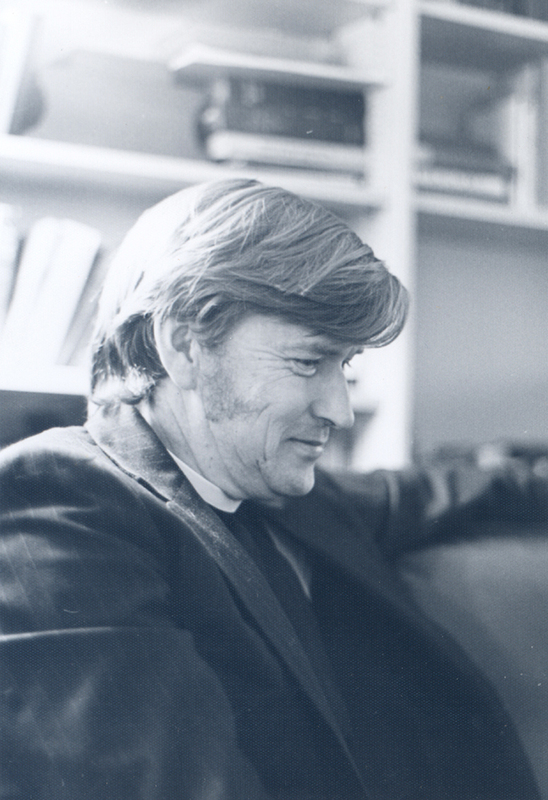
Promotional photograph of the Right Reverend John Shelby Spong for his book entitled This Hebrew Lord , 1974.
Born in Charlotte, North Carolina, Bishop Spong was educated in the public schools of Charlotte, graduated from the University of North Carolina in 1952 and received his Master of Divinity degree three years later from Virginia Theological Seminary. He was ordained a deacon and priest in 1955.
After serving as rector of St. Joseph’s Church in Durham, North Carolina for two years, Spong became the rector of Calvary Church in Tarboro, North Carolina in 1957. Despite the ruling on Brown vs. the Board of Education three years prior to his arrival in Tarboro, the schools in the town were not integrated until 1964. Spong stressed to his white congregation the importance of abiding by the integration laws and urged his parishioners against the use of violence as he witnessed the town’s deep division on this matter. While serving at Calvary, Spong also ministered to the Black Episcopal congregation at St. Luke’s. Despite ostracization and threats from the white community, Spong continued to work with the Black community, saying later, “The small, black faith community at St. Luke’s educated me in many ways. Its people also loved me, and by doing so helped to break open the residual racism of my childhood upbringing. The pastoral experiences I had there transformed my consciousness.”
In 1976, Spong was consecrated Bishop of the Episcopal Diocese of Newark, serving in that capacity for twenty-four years. As bishop, Spong continued to work tirelessly for civil rights and social justice. As a champion of groups marginalized in the church, he sought full acceptance and participation for gay Episcopalians. In 1989, he ordained a non-celibate gay deacon to the priesthood, inciting both supporters and detractors. He credited his childhood in the South as the catalyst for his life’s work as he witnessed injustice, racism, sexism, and fundamentalism.
Spong served on the Standing Commission on Human Affairs and Health and the House of Bishop’s Theology Committee. He served as a deputy to General Convention three times before becoming a bishop. He was a trustee of the Episcopal Theological Seminary and St. Paul’s College and held the position of president of the New Jersey Council of Churches. After retiring he lectured at Harvard and Oxford University. He was elected the Quatercentenary Scholar at Emmanuel College of Cambridge University.
Spong was well-known for challenging commonly held doctrines. He wrote over one hundred articles and eighteen books, including Why Christianity Must Change or Die; Here I Stand: My Struggle for a Christianity of Integrity, Love & Equality; Liberating the Gospels: Reading the Bible with Jewish Eyes; Resurrection: Myth or Reality?; Born of a Woman; Rescuing the Bible from Fundamentalism; Living in Sin? and This Hebrew Lord.
Bishop Spong's personal papers are located at The Archives of the Episcopal Church.
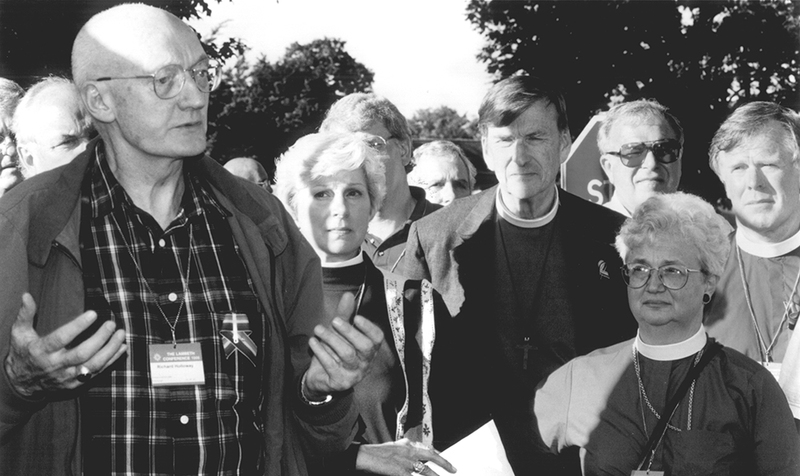
Bishops of the Anglican Communion, including Primus Richard Holloway of the Episcopal Church of Scotland (left), Bishop Catherine Waynick (center left), Bishop Spong (center right) and Bishop Catharine Roskam (right), object to a Lambeth Conference resolution "rejecting homosexual practice as incompatible with scripture," 1998.