
Sin of Racism
“The essence of racism is prejudice coupled with power.”
- The House of Bishops, Pastoral Letter on the Sin of Racism, 1994

This booklet brings together key statements issued by the Episcopal Church on the subject of race and covers almost a quarter-century, 1940 to 1963.
The 1991 General Convention met in Phoenix, Arizona, the only state at the time that had not yet adopted the holiday honoring Dr. Martin Luther King, Jr. That year, the Executive Council’s Commission on Racism noted in its Blue Book report that the work of The Episcopal Church in confronting institutional racism, while “not insubstantial,” was “incomplete.” The 1991 General Convention resolved to “spend the next three triennia addressing institutional racism inside [the] church and in society” (Resolution 1991-D113). A flurry of resolutions that year urged dioceses to conduct institutional racism audits; celebrated 200 years of the Black presence in The Episcopal Church; declared racism a sin and “called upon all baptized members of the church to work to remove racism from the life of the nation”; instructed interim bodies to examine how discrimination limited their work; urged church leadership to increase diversity in appointments to church positions; and urged dioceses and congregations to work towards “becoming a church of and for all races” (Resolutions 1991-A199; 1991-D149, 1991-B051, 1991-A085; 1991-A082, and 1991-D043). The Convention also adopted resolutions adding Jonathan Daniels to the Calendar of the Church Year and established the Episcopal Martin Luther King, Jr. Legacy Scholarship Fund to provide scholarships for students of color (Resolutions 1991-B006 and 1991-A241).
The seeds planted during discussions on institutional racism in Phoenix bore fruit in 1994 with the House of Bishop’s Pastoral Letter on the Sin of Racism. In the letter, the House of Bishops recognized that “institutionalized preference, primarily for white persons, is deeply ingrained in the American way of life.” It further established that racism is “rooted in the sin of pride and exclusivity which assumes ‘that I and my kind are superior to others and therefore deserve special privileges” and acknowledged that “in our religious tradition the people of the covenant have frequently expressed this attitude.” In response, the bishops committed to evaluating their own racist attitudes towards others, recognizing that they were part of a body infected with racism, listening to marginalized people, including people of color in decision-making, and developing diverse liturgical expressions. The letter invited Episcopalians to join the bishops in recalling the baptismal covenant: “Will you strive for justice and peace among all people, and respect the dignity of every human being? I will, with God’s help.”
That Pastoral Letter opened a General Convention that continued The Episcopal Church’s commitment to address racism on both institutional and personal levels, urging Episcopalians to follow the lead of the bishops in taking a “personal inventory of racist attitudes” as a basis for transformational change (Resolution 1994-D136). Additionally, General Convention encouraged both the elected and appointed bodies of the church and the parishes to prioritize “overcoming the sin of racism;” (Resolutions 1994-A048 and 1994-A047). The 1994 General Convention passed further resolutions to strengthen recruitment and retention of people of color in lay and ordained ministry; fund congregations in ethnic minority communities; and urge dioceses to establish Commissions on Racism to hold them accountable in the process of integrating people of color into the church (Resolutions 1994-A046, 1994-A045, 1994-B029, and 1994-D135). The work was reaffirmed during the 1997 General Convention, which also mandated the Executive Council establish a resource center for anti-racism educational materials (Resolutions 1997-A039 and 1997-D075).
The Sin of Racism
The draft of the House of Bishops’ pastoral letter was introduced by the Bishop of Western Michigan at the September 1993 interim meeting of the House of Bishops. The final version of the pastoral letter on “The Sin of Racism,” was issued at the 1994 General Convention by the House of Bishops and addressed the sin of racism, pinpointing the cause of racism as fear. The Bishops pledged to take steps to address the racism inherent within each of them and invited all Episcopalians to join them in this effort to confront and eradicate racism. It was shared with the wider Episcopal community and the world in a press release published by the Episcopal News Service.
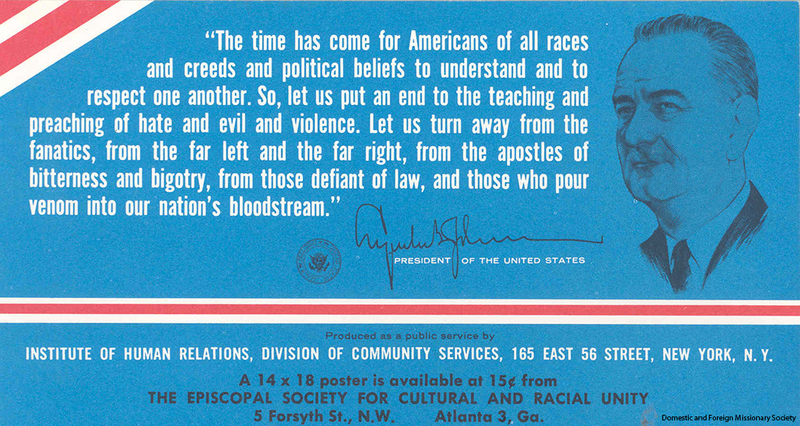
Poster produced by ESCRU featuring President Lyndon B. Johnson’s position on racism, c. 1968.