
Richard Allen, 1760-1831
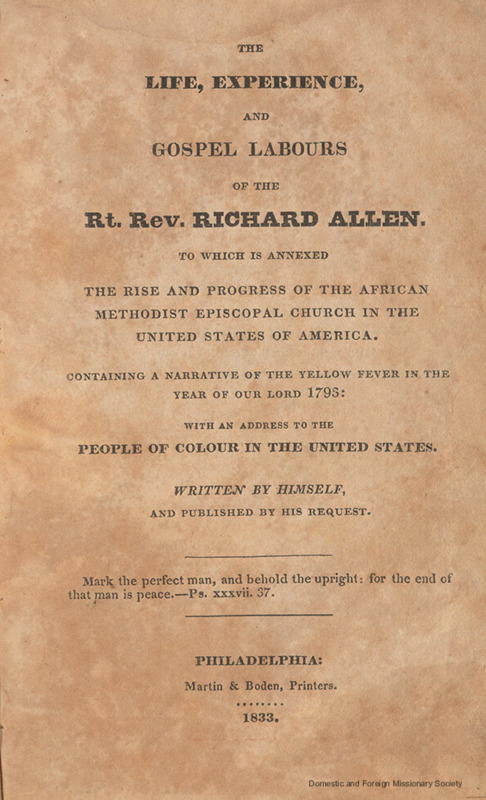
The Life, Experience, and Gospel Labors of the Rt. Rev. Richard Allen.
Born into enslavement in Philadelphia, Richard Allen and his family were sold to Stokeley Sturgis, a Delaware plantation owner. With Sturgis’ permission, Allen began attending Methodist formation classes and later converted to the Methodist denomination at the age of 17. Allen’s sincerity made a deep impression on Sturgis who eventually allowed interracial religious gatherings on his property. Sturgis’ reservations against slave ownership were strengthened after his own conversion to Christianity, and in 1783 he allowed Allen and his brother to buy their freedom.
For the next six years, Allen traveled throughout South Carolina, New York, Maryland, Pennsylvania, and Delaware preaching to both Black and white congregants, while working as a sawyer and wagon driver to earn money. While attending the first organizing conference of American Methodism, he met Absalom Jones who shared his vision of “erecting a place of worship for the colored people.” Together they formed the Free African Society in 1787 which grew into the First African Church of Philadelphia.
While the Free African Society adopted Quaker practices, Allen remained a staunch Methodist. In 1789, Allen, along with others who preferred more traditional Methodist practices, withdrew from the society. Allen founded Bethel in 1794, an independent Black Methodist church, which became known as the “Mother” church of the African Methodist Episcopal Church. Ordained a deacon in 1799, Allen was consecrated the first bishop of the new denomination in 1816. Richard Allen remained an ardent activist on behalf of the Black community until his death in 1831.