
The Reverend John Burnett Morris, 1930-2010
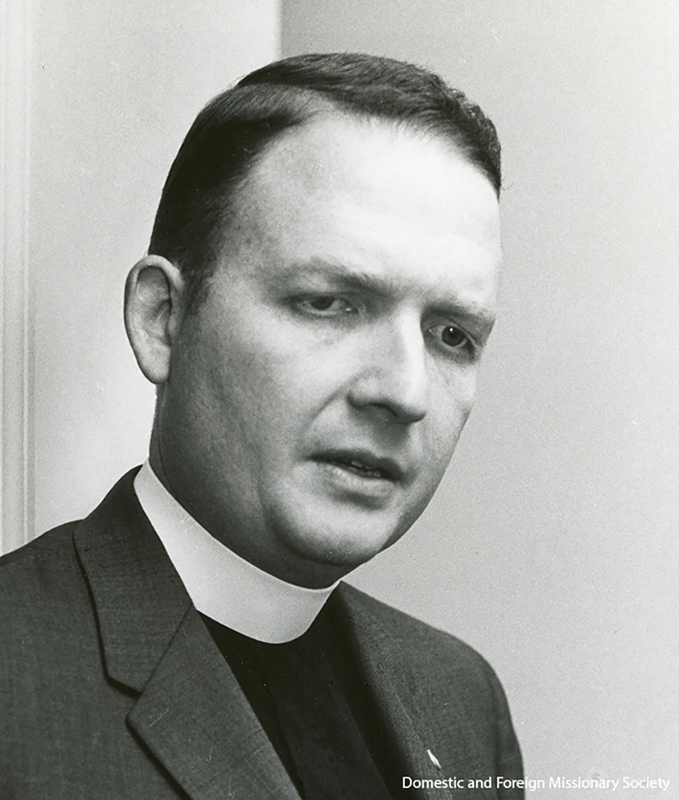
Rev. John Morris served as Executive Director of ESCRU from 1960-1967, c. 1960s.
The Reverend John Morris is remembered in The Episcopal Church for his activism against segregation and leadership as a founding member and Executive Director of the Episcopal Society for Cultural and Racial Unity (ESCRU). Born and baptized in Brunswick, Georgia, February 10, 1930 to Hervey Clark Morris and Annie Wright (Burnett), Morris attended Columbia University where he graduated with a Bachelor of Arts in 1951. Shortly thereafter, in 1952, he married Harriet Barnes Pratt. Two years later, he graduated from Virginia Theological Seminary with a Bachelor of Divinity degree. Morris was ordained to the priesthood in 1955.
Morris served as parish priest in South Carolina from the time he was ordained until the formation of ESCRU. In December of 1959, along with the Reverends Neil Tarplee and Arthur Walmsley (members of the Episcopal Executive Council) Morris submitted a paper entitled, "A Proposal: Formation in the Episcopal Church of a Church Society For Racial Unity" to at least five hundred potential members. Three hundred responded positively. The group adopted the name “Episcopal Society for Cultural and Racial Unity” and immediately took issue with the de facto racial segregation that dominated church life in the South, which included refusing Black community members admission to church-run institutions and to white worship services.
Appointed Executive Director of ESCRU in 1960, John Morris grew the organization from one hundred initial members to over 5,000 in twenty-nine chapters by 1966. Throughout his tenure he took considerable personal and professional risks to promote full integration of church institutions as the only morally defensible strategy to end racism and renew society. Morris officially retired in 1966 but continued to participate in ESCRU until its influence waned in the 1970s.
The Reverend Morris did not end his fight for human rights upon leaving ESCRU – he served as a Special Assistant to the Southern Regional Council, an independent organization providing “research to influence public policy around democratic rights and economic fairness,” from 1968 to 1970. From 1971-1981, Morris shared his passion for racial unity and justice with the entire nation as the Civil Rights Specialist for the cabinet-level U.S. Department of Health, Education, and Welfare.