
The Right Reverend Cedric Earl Mills, 1903-1992
There is no time in God's plan for a black heaven and a white heaven. There is no time for a white church and a black church. This is the church of God. This God has never been known to be any color.
- Cedric Earl Mills
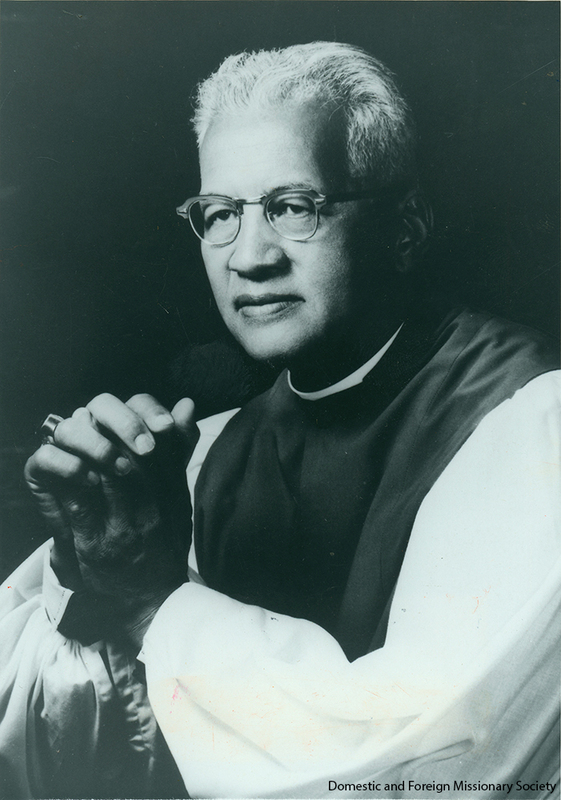
The Right Reverend Cedric Earl Mills was consecrated the first Bishop of the Virgin Islands in The Episcopal Church, c. 1964.
Cedric Earl Mills, the first Bishop of the Virgin Islands, was born December 17, 1903 in Hartford, Connecticut. Committed to civil rights and a leader in diocesan affairs, Mills established several missions, churches, and schools during his lifetime.
Mills attended Lincoln University in Pennsylvania, where he earned his Bachelor of Arts degree in 1926. He married Rebecca Esther Taylor in June of the same year. The couple had one child. Mills received his Master's degree from the University of Pennsylvania in 1929 and completed his theological training at Philadelphia Divinity School. He was ordained to the diaconate in October 1929 and to the priesthood two months later. From 1929 to 1937 he was Priest-in-charge of Ascension Chapel in West Chester, Pennsylvania. While in West Chester, he served at St. Cyril's Mission in Coatsville, Pennsylvania and St. Mary's Church in Chester, Pennsylvania and as Chaplain for the Episcopal students at Lincoln University, Cheyney State Teachers' College, and Dovington Industrial School. In addition to serving as Chaplain, Mills was the commandant of boys and taught science and mathematics. From 1937 to 1940, he was Priest-in-charge of St. Mark's Church in Plainfield, New Jersey. During his short tenure there, Mills eliminated the mission's indebtedness and began to develop the mission into a parish.
In 1940, Mills became Rector of St. James' Church in Baltimore, Maryland, where he would serve the church and community for twenty-two years from the diocesan to the national levels, including Secretary to the Army and Navy Commission of the Diocese of Maryland; member of the Diocese of Maryland’s Executive Council; member of the Executive Council of The Episcopal Church; member of the Standing Committee of the Diocese of Maryland; and chairman of the Associate Study Commission of Maryland, which proposed the first reorganization of the diocese. In 1961, he served as a deputy to General Convention.
Recognizing the interdependence between the church and politics, Mills used resources inside and outside of the church to effect social change. During World War II, he led protests against segregation in schools. He also worked for racial equality as a member of the Government Commission on Problems Affecting the Negro Population and as a member of the Board of Directors of the NAACP.
A believer in the importance of education, Mills worked with many organizations in Baltimore. He was chairman of the Parent-Citizens Committee on Education; a member of the Advisory Committee of the Henryton School of Practical Nursing; chairman of the Survey Committee on Education; member of the Board of Managers of the George P. Bragg Fund; and counselor to the student nurses at Provident Hospital.
In recognition of his accomplishments in the Church and in Baltimore, Mills was elected as the first Bishop of the Virgin Islands at a meeting of the House of Bishops in Columbia, South Carolina in 1962 and was consecrated on April 9, 1963 by Bishop Noble C. Powell of Maryland. That same year, full ecclesiastical authority in the British Virgin Islands passed from the Church of England to The Episcopal Church, Formerly the two institutions had shared jurisdiction making Bishop Mills the first leader of both national groups.
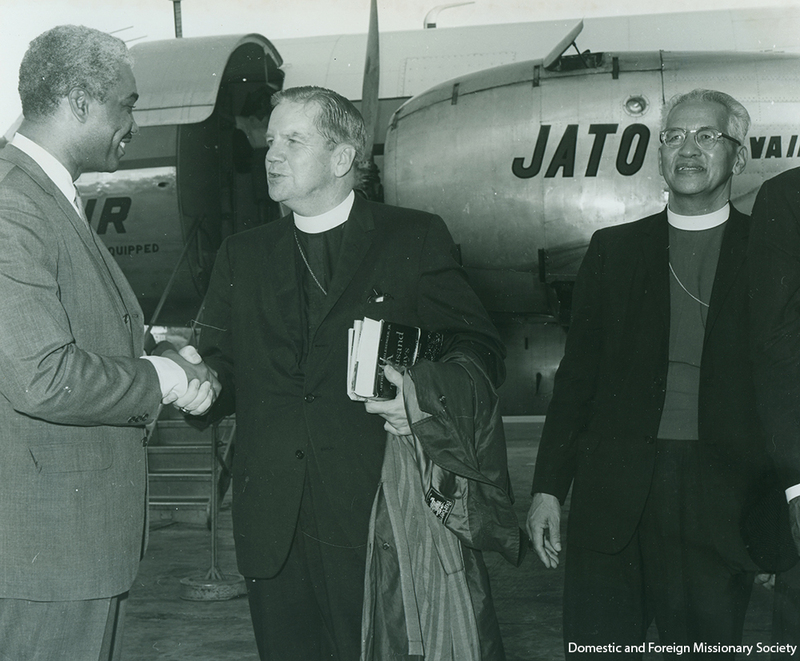
Cyril E. King, Virgin Island Government Secretary (left), and the Rt. Rev. Cedric Earl Mills (right) welcome Presiding Bishop Hines (center) to St. Thomas, Virgin Islands, c. 1970.
When Mills arrived in Charlotte Amalie, Virgin Islands, there were five Episcopal parishes and three Anglican parishes, with a total of 10,456 baptized members, but there was not yet an Episcopal residence. Immediately upon his arrival, Mills encouraged the diocese to share in the building of a residence on the islands in an effort to show that the relationship between the larger church and the missionary dioceses was one of mutuality rather than dependence. By contributing to the residence, Bishop Mills felt his parishioners could prove that a missionary diocese could give as well as receive and that their contributions would strengthen their connection to the church.
Mills called upon the companion Diocese of Maryland to assist with funding schools and a scholarship program in the Virgin Islands. He expanded the presence of the church among the people of the Islands, challenging the laity to serve their community as Christians and calling for the construction of local parish churches across the Islands instead of devoting all of the diocese’s financial resources to a single cathedral. Committed to using the resources of the church for the benefit of the entire community, Mills fought to ensure that the children of the Islands' primary workforce, immigrants, had access to public education. Mills served as member of the Implementation Committee for the Alien Worker and His Family in 1967, and in 1969 he was appointed by the Governor as a member, later becoming Vice Chairman of the Special Commission to Study and Make Recommendations on the Status and Problems of Non-Citizens in the Virgin Islands.
In 1972, at the age of 69, Bishop Mills retired as Bishop of the Virgin Islands. For the next twelve years, he assisted Bishop Robert C. Rusack in the Diocese of Los Angeles. Bishop Mills passed away on July 3, 1992 at the age of 89.