
Thurgood Marshall, 1908-1993
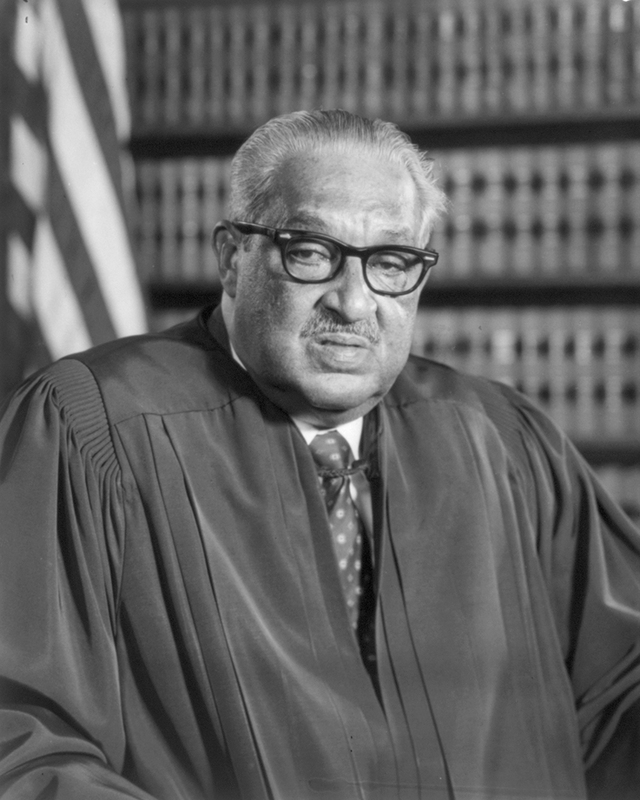
The Honorable Thurgood Marshall won Brown v. Board of Education before the Supreme Court. He was appointed a justice thirteen years later, 1976.
Thurgood Marshall was born in 1908 in Baltimore, Maryland, the grandson of an emancipated enslaved woman. He attended Baltimore public schools and then the historically Black Lincoln University in Pennsylvania. In 1930, he applied to the University of Maryland Law School, but was denied admission due to his race. The indignity of this event would influence his future professional life. After graduating first in his class and receiving his law degree from Howard University, Marshall successfully sued the University of Maryland, resulting in the admittance of minority students.
In 1936, Charles Hamilton Houston, former Howard Law School dean and chief counsel for the National Association for the Advancement of Colored People (NAACP), called Marshall to be his deputy in New York. Four years later, Marshall became the first director of the Legal Defense Fund, dedicated to civil rights advocacy and litigation. In 1954, as chief counsel for the NAACP, he argued and won the landmark Brown vs. Board of Education case before the Supreme Court. The decision refuted the idea of “separate but equal” public schools and was one of many challenges to state-sponsored discrimination that Marshall argued and won. He devoted thirty years traveling the South fighting for the rights of America's oppressed minority on behalf of the NAACP’s Legal Defense and Educational Fund before his appointment by John F. Kennedy to the U.S. Court of Appeals for the Second Circuit in 1961. He wrote over 150 decisions as an appellate court judge, including support for the rights of immigrants, limiting government intrusion in cases involving illegal search and seizure, double jeopardy, and right to privacy issues.
Marshall was promoted to Solicitor General of the United States in 1965 by President Lyndon Johnson. Before his subsequent appointment as Supreme Court Justice in 1967, he won fourteen of the nineteen cases he argued before the nation’s highest court. He was the first African American to hold either position and served for twenty-four years on the Court, retiring in 1991.
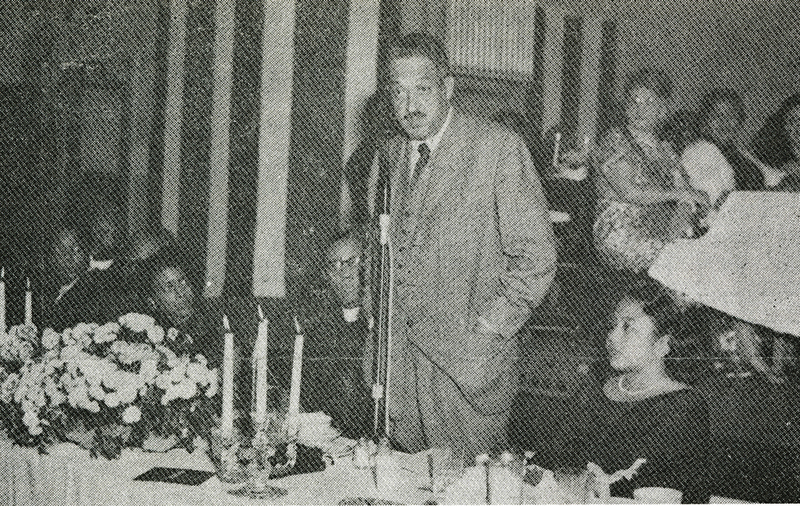
Hon. Thurgood Marshall, future Supreme Court Justice, long-time St. Philip's member, addresses the Annual Parish Dinner audience in 1957.
A cradle Episcopalian, Marshall was an active member of St. Philip’s Church in Harlem, New York from his arrival in 1938 where he served on the Vestry and as Senior Warden. He also served as a deputy to the 1964 General Convention. In 1965, the Marshall family moved to Washington, D.C. and joined St. Augustine’s Church. Alongside being a dedicated Episcopalian, Marshall was an ardent believer in the separation of church and state. Consequently, he attended church infrequently after his appointment as Supreme Court Justice, concerned that he would develop biased political views which would influence his judgement.
Deputies to the Diocese of Washington's annual convention voted to submit a resolution at the 2006 General Convention requesting inclusion of Thurgood Marshall in The Episcopal Church's Calendar of the Church Year. In written testimonies accompanying the resolution, a priest of Marshall's former parish stated that, "The Spirit working through this man gave him an intuitive sense of justice in which he saw all of life as sacred and all persons equal before God." At the 2018 General Convention a commemoration for him was added to the Calendar of the Church Year by the 2018 General Convention.