
The Lovett School
"I regret personally the decision of the school's Trustees. I have three children enrolled there.
It is a good school. I had hoped that my Church would provide my children
with the enriching opportunity of learning to live and love with all people."
-Rev. John Morris
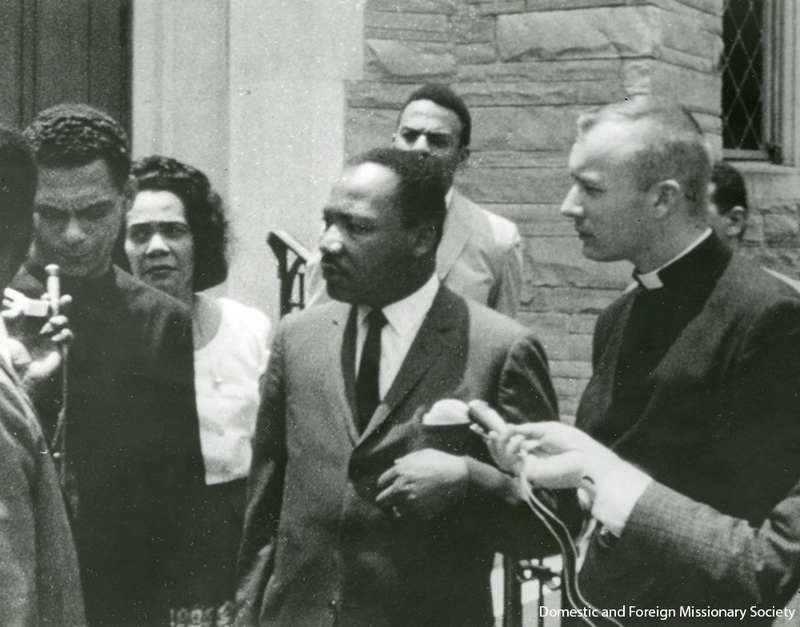
Martin Luther King, Jr., accompanied by Mrs. Coretta Scott King and Andrew Young, speaks after his son was denied accepance to the Lovett School.
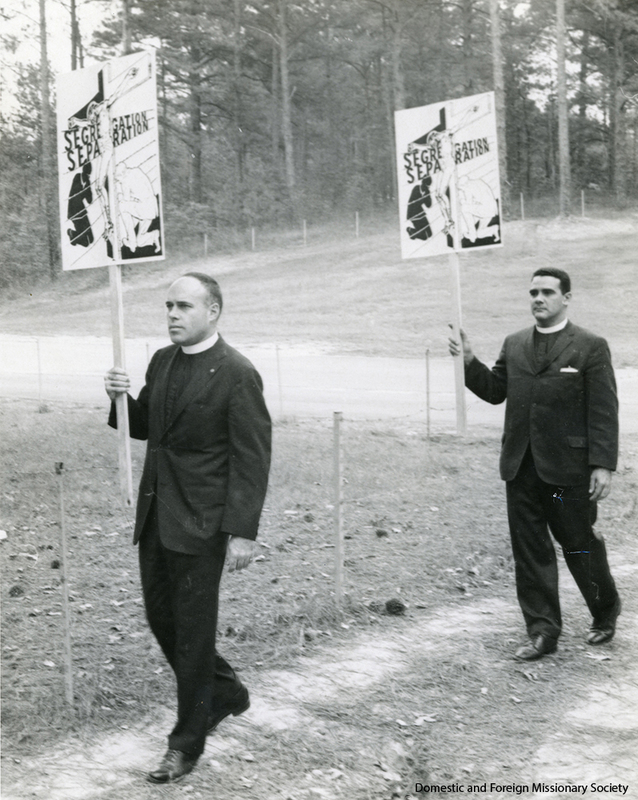
ESCRU members, the Rev. Malcolm Boyd and the Rev. Henri A. Stines, picketing in front of Lovett School, 1963.
Lovett School, an all-white private school in Atlanta, had a long association with The Episcopal Church that was guaranteed by the school’s charter, which stated that two-thirds of the Board of Trustees had to be Episcopalian and an Episcopal priest was traditionally employed as the headmaster. On February 2, 1954, the school merged with the Cathedral of St. Philip, and in doing so, the Lovett School passed all of its property to the control of the Cathedral.
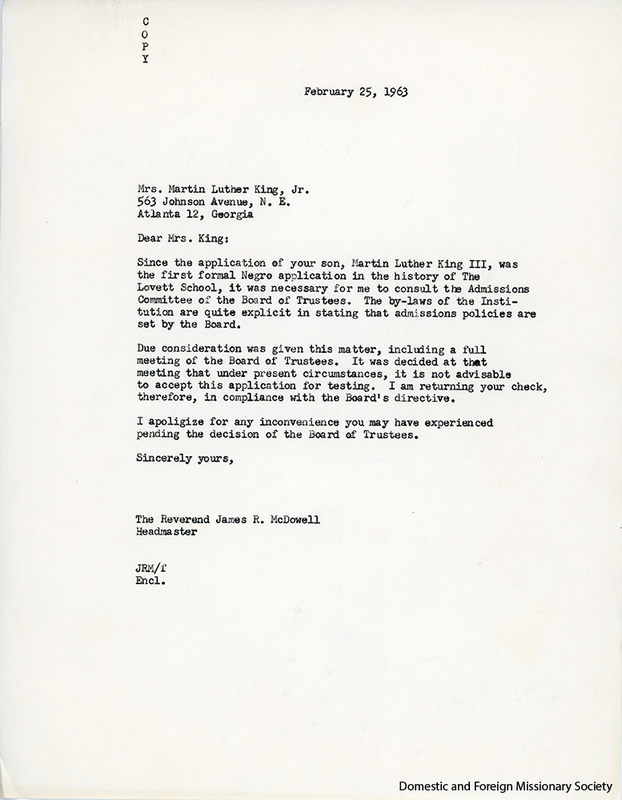
In the early 1960s, as members of the clergy from many denominations called for the full integration of public facilities across the South, including schools, the Lovett School found itself in the center of controversy. While the Lovett School had no formal policy regarding the race of students it admitted, The Episcopal Church had a policy that fully supported integration in public spaces. With that in mind, the Rev. John Morris, founder of ESCRU, whose daugher attended Lovett, suggested that the Rev. Martin Luther King, Jr. and his wife, Coretta, submit an application for their son, Martin Luther King III, in the spring of 1963. Stating that they were seeking out the best education for their son, the King family denied allegations that they were specifically trying to integrate the Lovett School or to cause social and political tension.
When faced with the first application of a Black student, the school unanimously adopted resolutions denying the applications of African American students and rejected the application of the King family. In protest of the school’s decision, the Rev. James McDowell resigned as headmaster in June of 1963, stating that as an Episcopal priest in favor of open churches and schools, he could not support the actions of the Lovett School.
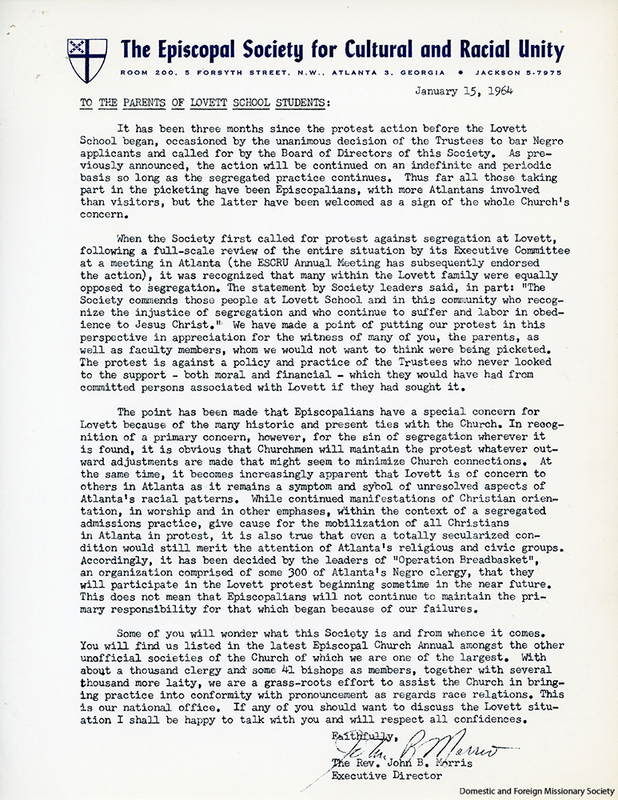
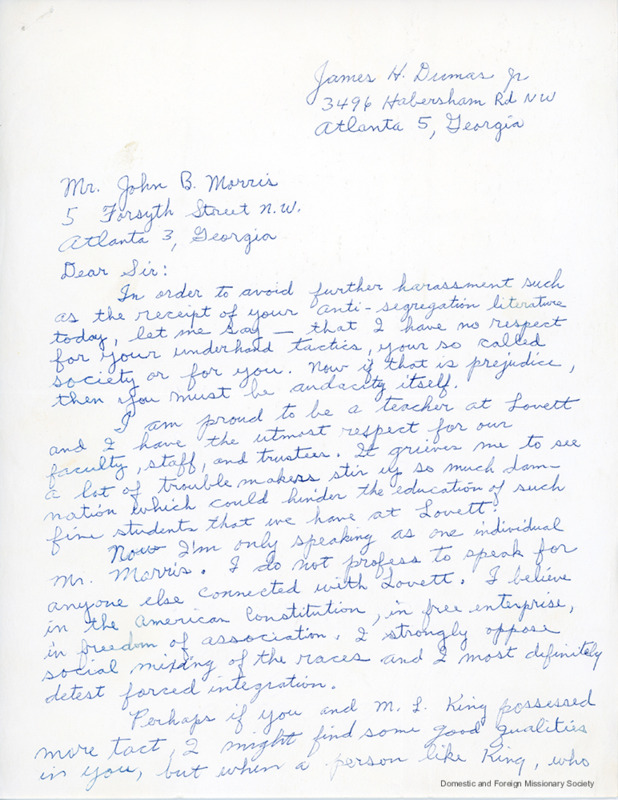
Undeterred by the headmaster’s resignation and determined to uphold a segregated institution, parents and members of the Board of Directors faced off against ESCRU and other church members who demanded a change in policy. A picket of the school began in the Autumn of 1963 and occurred on approximately half the school days in October and November. ESCRU members and other church supporters endured taunts, hate mail, and months of inclement weather to effect a change in the school’s policy. The picketing continued into early 1964.
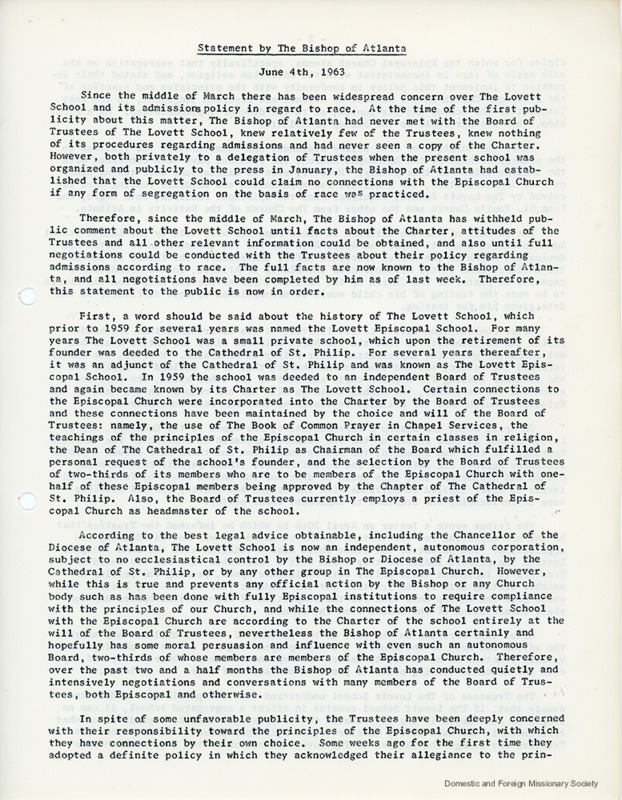
To prevent integration, the school board amended the Lovett School’s charter and by-laws, stating that they had no official ties to The Episcopal Church and as a private institution, they could continue to deny admittance of Black students. In response, the Bishop of Atlanta, Rt. Rev. Randolph Claiborne, issued a statement on July 1, 1963 advising that the Lovett School “is an independent, autonomous corporation, subject to no ecclesiastical control by the Episcopal Church,” and would no longer receive any implied or official support from The Episcopal Church. Despite the formal dissolution of support, the dean of St. Philip's Cathedral remained the chair of the board of the Lovett School and the provision requiring two-thirds of the board members to be Episcopalian remained in place. When John Morris publicly challenged Bishop Claiborne to uphold The Episcopal Church policy on desegregation, arguing that The Episcopal Church was still supporting the school by allowing the Baccalaureate services to be held at St. Philip’s Cathedral, holding Episcopal religious services, and enjoying the service of several prominent Episcopalians on the school’s Board of Trustees, Bishop Claiborne refused to discuss the matter further and Morris resigned his license to officiate within the Diocese of Atlanta in protest.
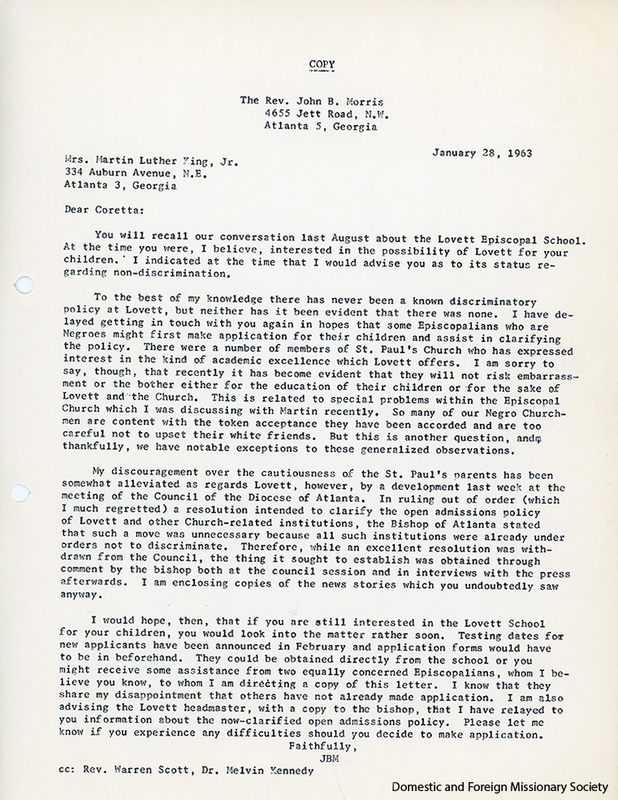
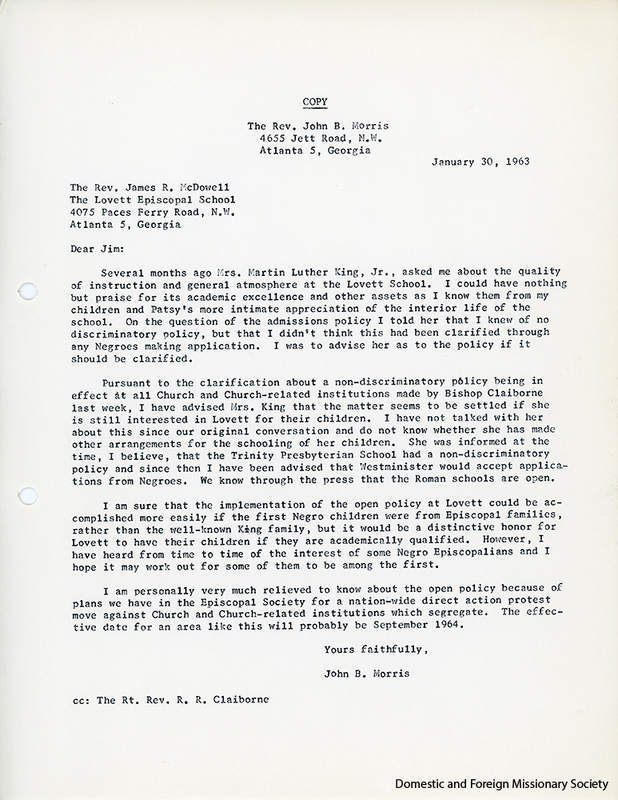
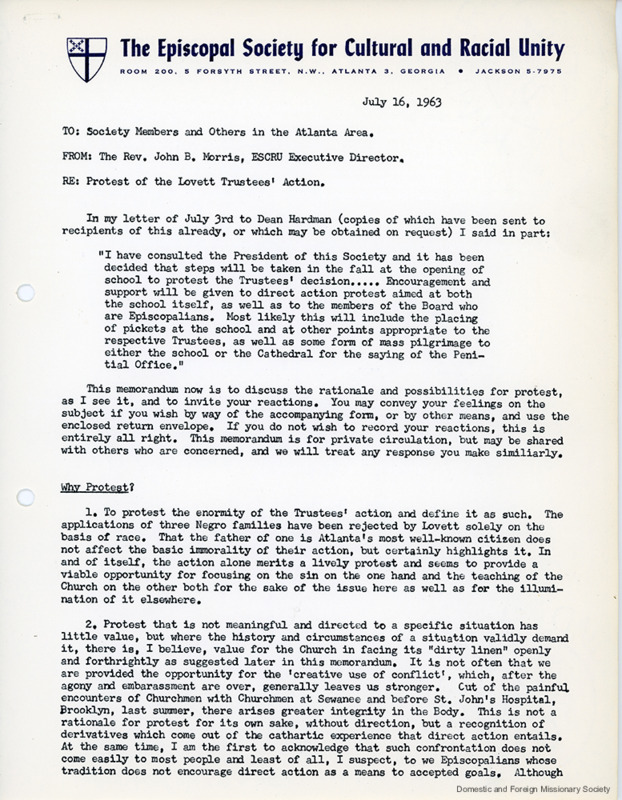
ESCRU Statement explaining "Why Protest", 1963
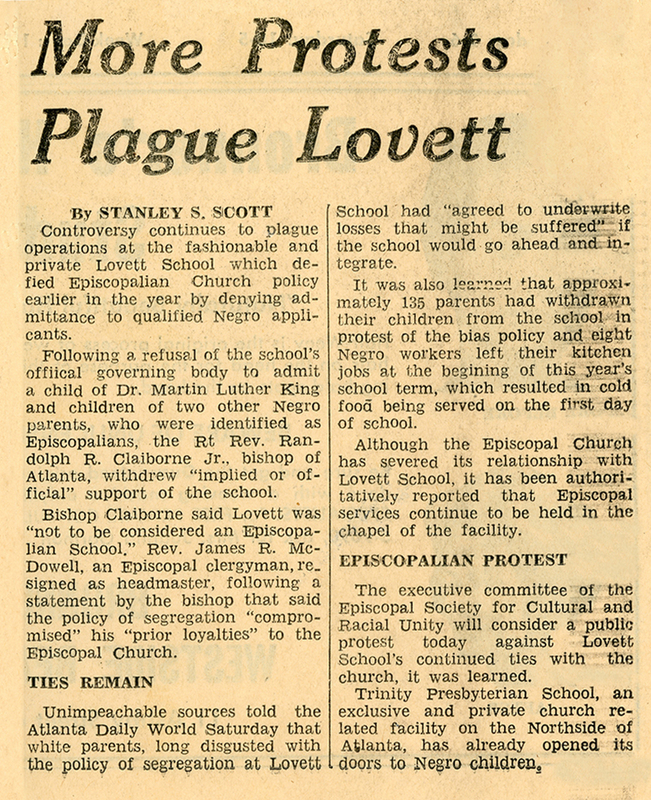
An article from the Atlanta Daily World, reporting on the protests in response to the Lovett School's refusal to admit African American children.