
The Reverend Kortright Davis
Change is action: it is the radical transformation of oppressive structures; it is the overthrowing the tables of the money-changers in the temples; it is the singing of a new song in a new key that sounds cacophonous to those who think that music belongs to them; it is making the counterculture of the gospel come alive in a way that threatens the little kings but announces afresh the inbreaking of the kingdom of God.
- Kortright Davis, Two Caribbean Theologies of Freedom
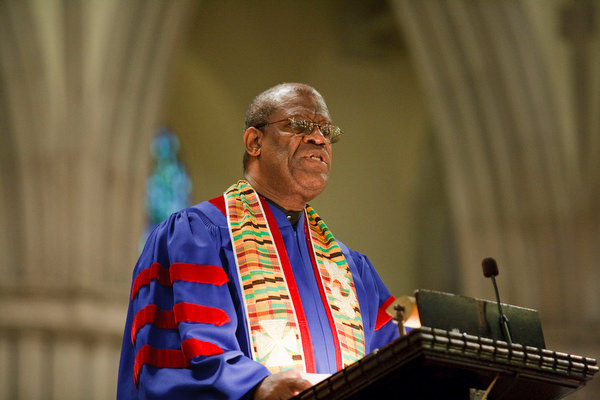
The Rev. Dr. Kortright Davis preaching at the 14th annual Black Heritage Service at St. Paul’s, Bloor Street, Toronto, Feb. 22, 2009. Photo courtesy of Michael Hudson/The Anglican.
Donald Henry Kortright Davis was born in Antigua, the West Indies, in 1941. He studied at Codrington College, Barbados, and received his Bachelor of Divinity externally from London University. Following this, he received the first post-graduate degree in History awarded by the University of the West Indies and continued his career at the University of Sussex, becoming the first West Indian to earn a Doctorate in Religious Studies from that institution. After serving as Vice-Principal and Acting Principal of Codrington College, he joined the faculty of Howard University in 1983 and became a full Professor of Theology four years later. He has received honorary degrees from the General Theological Seminary, St. Paul’s College, and the University of the West Indies.
Davis was ordained to the priesthood in 1966 in the Diocese of Antigua. His upbringing in the West Indies, along with his years of service to parishes in Antigua, St. Kitts, Montserrat and Barbados, provided the foundation for the “emancipatory theology” that characterized his ministry, instilling in him the deep belief that, although religion was a primary tool of colonial oppression, the Gospel message contains in itself the key to liberation. In the deeply religious West Indies, in which “God was not a distant deity but a very present help in all circumstances,” Davis understood that it is possible to be free in God even in the midst of poverty.
In 1986, Davis accepted the call to the Church of the Holy Comforter in Washington D.C., where he remains Rector Emeritus. He is also a representative on the Anglican Roman Catholic International Commission. Davis has left his mark on the Anglican Communion as one of the principal participants in the Conference on Afro-Anglicanism, founded in 1985, which resulted in the seminal Codrington Consensus, a statement bringing the insights of the African diaspora to the Anglican and Episcopal discussion on race. He has also been active in the Caribbean Conference of Churches, has served as a consultant to a variety of religious and academic institutions, and was a member of the Faith and Order Commission of the World Council of Churches.