
The Reverend Absalom Jones, 1746-1818
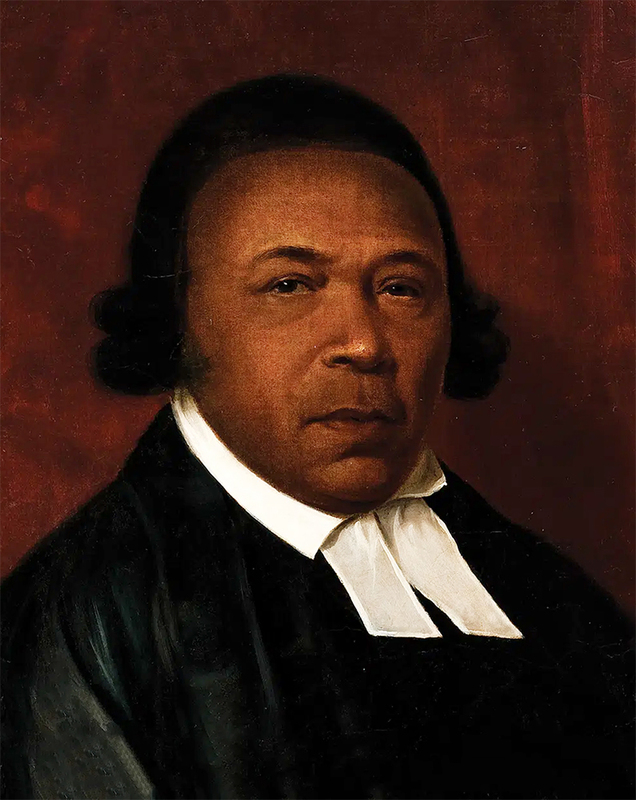
This famous image of Jones, held in the Delaware Art Museum, was rendered by Philadelphia artist Raphaelle Peale in 1810. Read the Rev. Canon Harold T. Lewis's sermon commemorating the life of Absalom Jones, February, 1991.
Absalom Jones was The Episcopal Church’s first Black priest. Born into slavery in Delaware at a time when slavery was being debated as immoral and undemocratic, he taught himself to read using the New Testament as one of his resources. At the age of 16, Jones’ mother, sister, and five brothers were sold, but his enslaver brought him to Philadelphia, Pennsylvania where he attended a Quaker night school for people of African descent. Upon his manumission in 1784, he served as lay minister for the Black membership at St. George’s Methodist Episcopal Church with his friend, Richard Allen. Together they established the Free African Society to aid in the emancipation of enslaved people and to offer sustenance and spiritual support to widows, orphans, and the poor.
The active evangelism of Jones and Allen greatly increased Black membership at St. George’s. Alarmed by the rise in Black attendance, in 1791 the vestry decided to segregate Black worshipers into an upstairs gallery without notice. When ushers attempted to remove the Black congregants, the group exited the church in protest.
In 1792, Jones and Allen, with the assistance of local Quakers and Episcopalians, established the “First African Church” in Philadelphia. Shortly after its establishment, the African Church applied to join the Protestant Episcopal Church, laying before the diocese three requirements: the Church must be received as an already organized body; it must have control over its own affairs; and Jones must be licensed as lay-reader and if qualified, ordained as its minister.
Upon its acceptance into the Diocese of Pennsylvania, the church was renamed the African Episcopal Church of St. Thomas. The following year Jones became a deacon, but he was not ordained a priest until seven years later, at 56 years old, in 1802. He continued to be a leader in his community, founding a day school, the Female Benevolent Society, and an African Friendly Society. In 1800, he called upon Congress to abolish the slave trade and to provide for gradual emancipation of existing enslaved people.
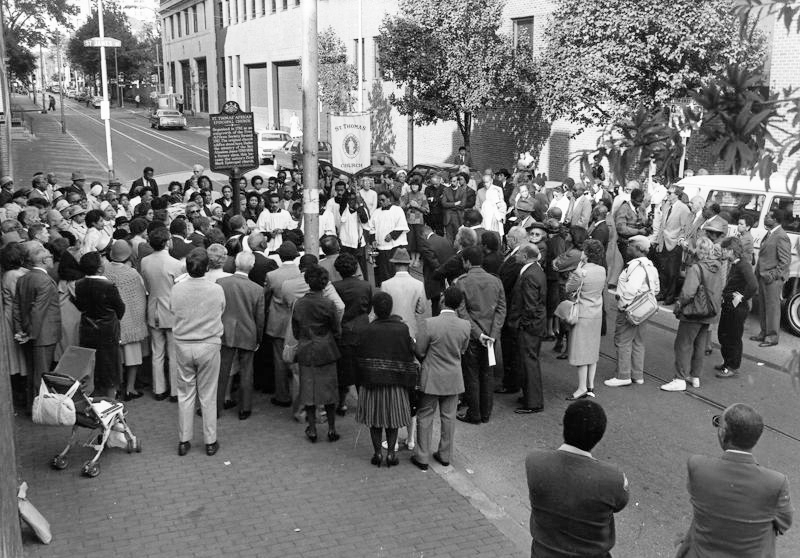
Dedication at St. Thomas's African Episcopal Church celebrating Absalom Jones' birthplace, c. 2005.