
Fannie Pitt Jeffrey, 1910-2004
I believe that I can best serve my people - the Negroes - by helping them to realize and accept the Christian way of life, I feel they need spiritual guidance and leadership that will reach deep into their personal lives and homes.”
-Fannie Pitt Gross
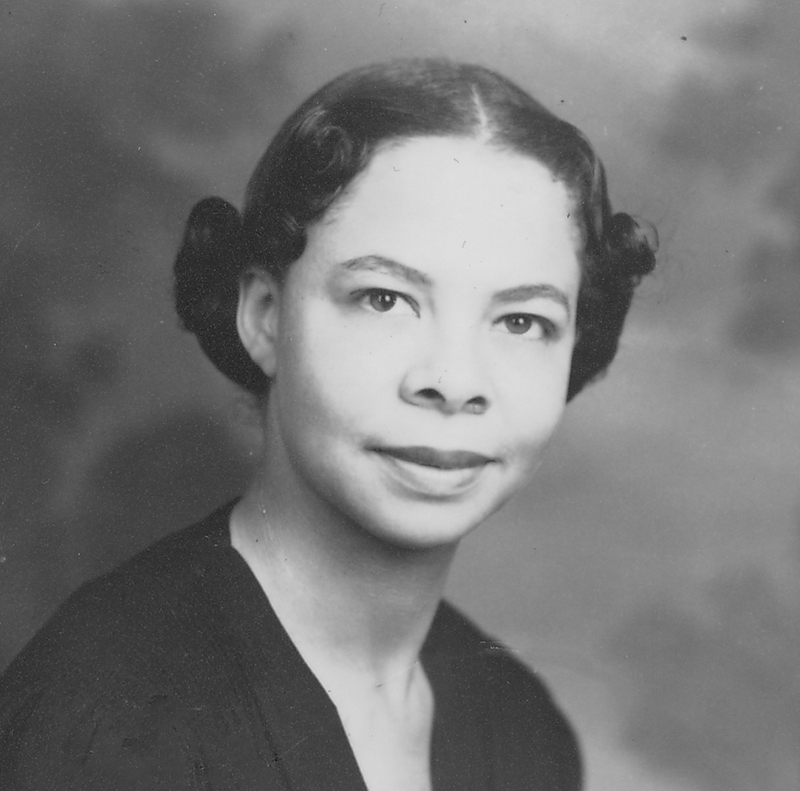
Fannie Pitt (Gross) Jeffery was a leader in religious education and dedicated to uplifting Black Episcopal congregations, c. 1938.
Fannie Pitt was born in Tuskegee, Alabama, on August 8, 1910. Her parents, Fannie Thompson and Claudius Pitt, met while working at Tuskegee Institute (today Tuskegee University). Her mother was an assistant in the cooking division at Tuskegee Institute from 1903 to 1906; her father was assistant bookkeeper from about 1903 to 1911. In 1914, Claude Pitt moved his family to Denver, Colorado. Born and raised in a family that valued education, Fannie also had an older sister, Florida, born in 1908, who was a pioneering educator.
She pursued her education and church work outside of Denver, graduating in 1926 from Dunbar High School in Washington, D.C. and earning her Bachelor of Arts degree from Colorado State College of Education in Greeley, Colorado, in 1930. Around this time, Fannie married James P. Gross, with whom she had a son, James P. Gross, Jr., born in 1934. She and Mr. Gross subsequently divorced.
Jeffery decided to specialize in religious education in 1938 while enrolled at the Bishop Tuttle School in Raleigh, North Carolina. During the summer of 1939, she served as a parochial worker for both St. Philip’s and St. Monica’s parishes in Washington, D.C.. That same year, she applied and was granted a Woman’s Auxiliary scholarship to study for one semester in New York. Jeffrey also was one of the first Black graduates of Windham House, which had a program that combined fieldwork with courses toward a religious education degree awarded by Union Theology Seminary. While working as national field secretary, Jeffrey explored her interest in religious and spiritual education by completing graduate course work in the Department of Religious Education at the Teachers College of Columbia University.
During her tenure with the Woman’s Auxiliary, the National Council of The Episcopal Church launched a program to reach out to Black congregations throughout the country. Inaugurated in 1943, the program sought to address issues such as poorly equipped church buildings, low stipends for Black clergy, and low numbers of communicants within Black congregations. The committee appointed to lead the program emphasized outreach to rural areas and communities with smaller resources. Jeffrey successfully accomplished such outreach by working with organizations such as the Tuttle Community Center in Raleigh, North Carolina. As national secretary, she also advocated for equal pay for Black and white employees of the United Thank Offering and supported increased opportunities for lay workers. Woman’s Auxiliary national staff often consulted her for recommendations on training and leadership.
Jeffrey’s position with the Woman’s Auxiliary ended in 1945, the year she married Mr. Lynn D. Byrd. Although documentation about her life beyond 1945 is limited, she later married Mr. Newman Jeffrey. Upon her death in October 2004, she was honored by members of St. Barnabas Church and the Denver chapter of Alpha Kappa Alpha sorority with the establishment of the Fannie Pitt Jeffrey Memorial Fund.