
The Reverend Robert Hunter, 1935-2020
The Reverend Robert Fulton Boyd Hunter was born in Alabama in 1935 to Robert and Ella Hunter. After receiving his BA from Fisk University in 1956, he attended Seabury Western Episcopal Seminary in Evanston, Illinois. He was ordained to the diaconate in 1959 and to the priesthood in 1960. Hunter began his career as assistant at Emmanuel Church in Memphis, Tennessee. After his ordination to the priesthood he was called to serve first at St. Mary’s in Chattanooga, Tennessee (1960-1964), and then to St. Paul’s Episcopal Church in Atlanta, Georgia (1964-1975). He then began a twenty-eight year ministry at Washington, D.C.’s Church of the Atonement (1973-2003).
Robert Hunter joined the Union of Black Episcopalians in 1961 and was active in the Civil Rights Movement. On two occasions he galvanized events for The Episcopal Church in protesting racial injustices within the church. In 1962, he and two other Black clergymen were refused service at the Claramont Restaurant in Sewanee, Tennessee. This treatment came despite protests the previous summer, which had ended with the proprietor, Clara Shoemate, being required to serve patrons of any race who were affiliated with the University of the South. Hunter and his two companions argued that although not connected to the school, they were entitled to service as visiting Episcopal clergy. Shoemate refused nonetheless and the Episcopal Society for Cultural and Racial Uunity (ESCRU) mounted a two-day sit-in.
In 1966, Hunter joined Albert Dreisbach to protest the use of Atlanta's St. Philip's Cathedral for the baccalaureate ceremony of the segregated Lovett School. Hunter endured a ninety-eight hour fast in the cathedral. Their protest began the Wednesday before the Saturday service and ended only after the service was over. It attracted an outpouring of attention and support for ESCRU, but Lovett School was not integrated for another four years.
Robert Hunter carried his deep commitment to justice and equality into his daily ministry, to the great benefit of his parishioners. Older members of St. Paul's Episcopal Church in Atlanta, where he served during the turbulent sixties and seventies, remembered the powerful effect of his witness and his devotion to personal ministry on their spiritual life, and many spoke of finding in St. Paul’s Church a community that was actively engaged with the world. While rooted in the Episcopal tradition, the parish still worked tirelessly towards spiritual renewal and greater justice within the Church itself.
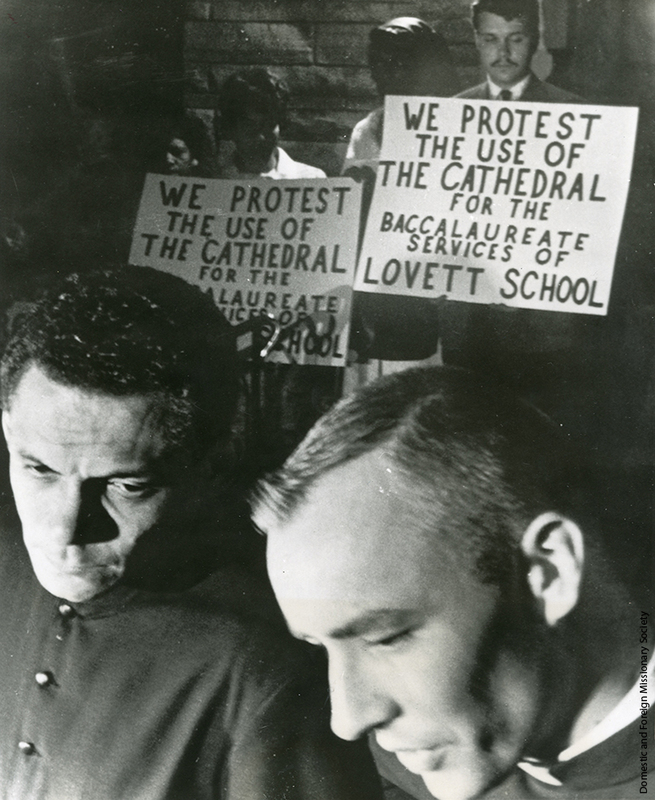
Reverends Robert Hunter (left) and Albert Dreisbach (right) fast for 98 hours in St. Philip's Cathedral to protest its use for the Lovett School service, June 1966.
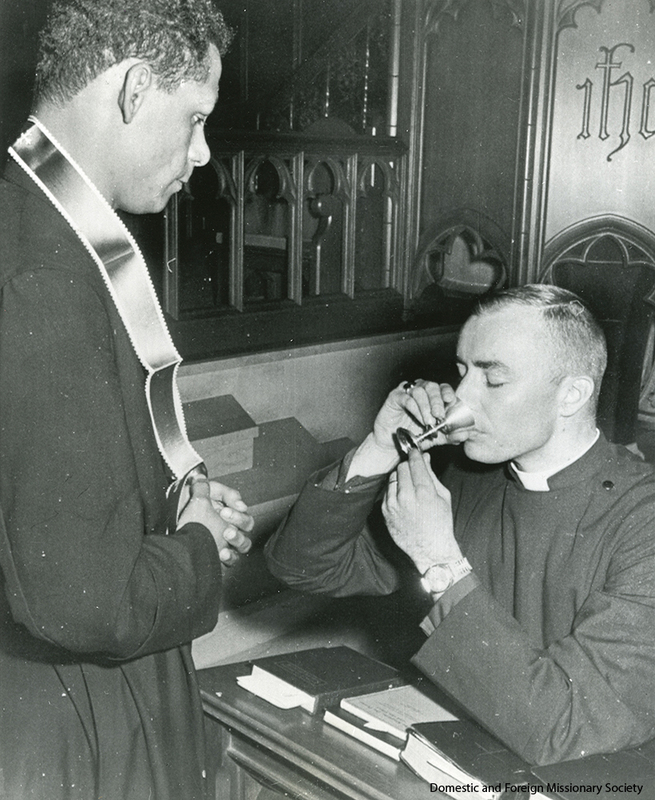
Reverends Robert Hunter (left) and Albert Dreisbach (right) hold communion during their protest fast at St. Philip's Cathedral, June 1966.