
The Reverend Kenneth de Poullain Hughes, 1902-1978
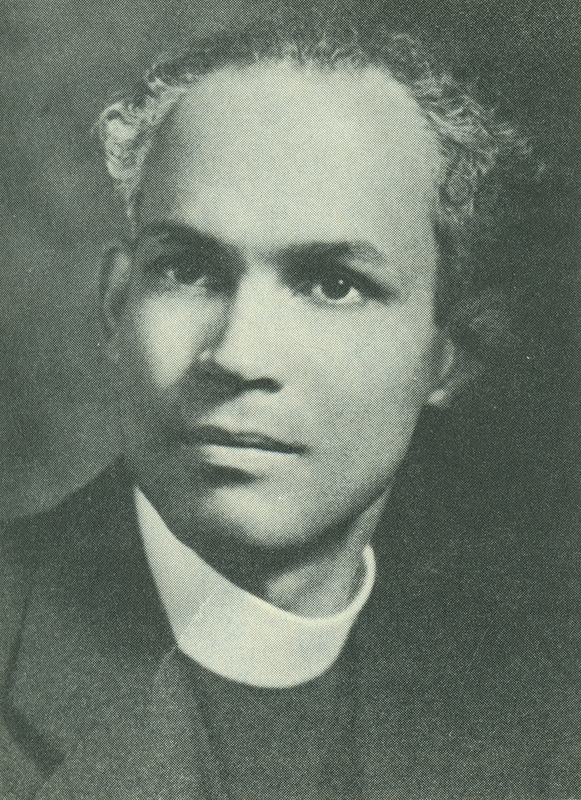
The Rev. Kenneth de Poullain Hughes, one of the founders of the Union of Black Episcopalians.
Kenneth de Poullain Hughes was born in Grenada on March 29, 1902. During the forty-four years of his ministry as an Episcopal priest, he served as a committed and outspoken advocate for racial improvement within the church and the broader communities of which he was a part. The trajectory of his ministry spanned many turbulent decades in which the United States and The Episcopal Church confronted racial injustice and Civil Rights reforms.
Hughes received his Bachelor of Arts at the City College of New York in 1929 and completed his seminary work at General Theological Seminary in 1936. His first call was to serve as Rector at Saint Mark’s Church in Charleston, South Carolina, where he would spend the next five years of his ministry. In Charleston, Hughes encountered many forms of racial intolerance and prejudice. Saint Mark’s was the only church in the diocese that was not considered “in communion” and Hughes was one of six priests who was not allowed a seat or voice at the diocesan convention. All six of these priests were associated with traditionally Black parishes. Although Saint Mark’s had sought recognition by diocesan leadership multiple times since its founding in 1866, Hughes would not see his church fully accepted by the diocese during his service as rector.
In January 1940, Hughes assumed duties as the Rector of Saint Bartholomew’s Church in Cambridge, Massachusetts. He served the remainder of his active ministry at this church until his retirement in 1970. Although Cambridge was outside of the American South, Hughes discovered that racial prejudice proved to be a factor there just as it had in South Carolina. He soon began to publicly challenge racial segregation within the church and society, writing several articles for The Witness in which he described the unequal nature of racial segregation this way, “the mere fact that [the Black parishioner] was separated was a limitation of his freedom and implied his inferiority and the superiority of his separators.” In his articles, Hughes articulated how segregation undermined Christian unity and how the practices of many Christians were at odds with the purported values of the church.
Hughes presided over considerable improvements to his church, including the relocation of Saint Bartholomew’s to Harvard Street into a building formerly occupied by the First Methodist Episcopal Society. The new church building, which was larger and included parish house facilities, was consecrated on November 9, 1941 and inaugurated a period of growth for the congregation. In 1945, Saint Bartholomew’s was admitted as a parish of the Diocese of Massachusetts under the guidance of Bishop Henry Knox Sherrill.
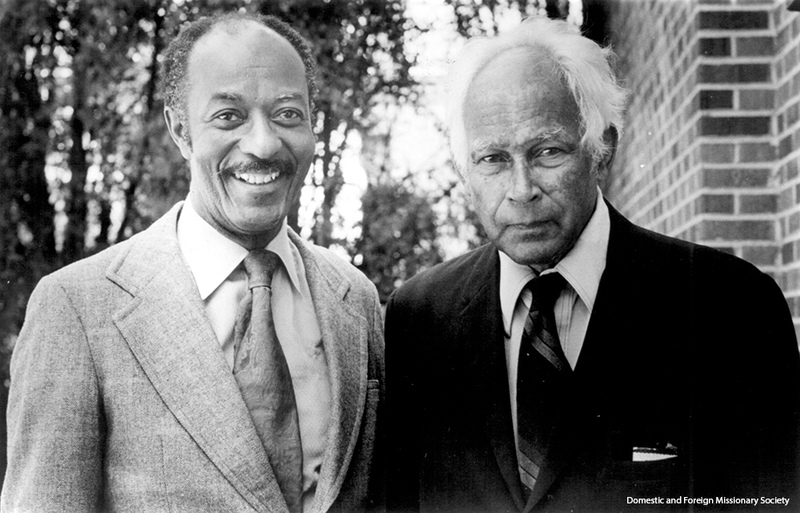
The Rev. Kenneth de Poullain Hughes, keynote speaker for the Conference on Minority Recruitment and Equal Opportunity Employment, with Mr. William Rucker (right), conference Chairman, 1977.
Hughes was a founder of the Union of Black Episcopalians, an organization that evolved from an earlier coalition of Black clergy to promote racial improvement in the church. In 1962, he was the recipient of the Bishop Norman B. Nash Fellowship of the Diocese of Massachusetts, an honor which enabled him to travel to several African countries to experience the church’s work in that part of the world. Following his retirement in 1970, Hughes remained active and was recognized for his continued advocacy against racial injustice. He served as the distinguished keynote speaker at the Committee on Minority Recruitment and Equal Opportunity Employment conference in 1977. In his remarks, Hughes noted that “The church is trying to correct past injustices and to enter into the 21st century…For that, I am thankful.”