
Freedman’s Aid Commission
The post-war activities of other denominations’ benevolent organizations caused some alarm in The Episcopal Church, which continued to lose Black members to them. In July 1865, an anonymous writer to The Spirit of Missions highlighted an urgent need for missionary work in the South to compete with the efforts of other religious bodies and especially the Freedman’s Association, which was largely Unitarian. Furthermore, Black clergy continued to lobby the House of Bishops for increased opportunities within The Episcopal Church for Black members. General Convention responded to these concerns in October with the creation of the Protestant Episcopal Freedman’s Aid Commission for “religious and other instruction of the freedmen;” however, the Commission’s Executive Committee expanded this role to include physical relief as well. The Commission called upon clergy to take up a collection for this purpose, solicit clothing donations, and form auxiliary societies for the aid of emancipated people.
By 1868, the Freedman’s Aid Commission reported serving 5,500 children and raising over $87,000. Nevertheless, the Committee of the Domestic and Foreign Missionary Society was concerned that the Freedman’s Aid Commission was providing largely secular knowledge and failing to draw Black people into the fold. The Committee wrote that “while schools alone are valuable agents they will not accomplish their full purpose, nor realize the full intention of the Church unless they are connected with permanent missionary work.” The Episcopal Church, they said, had no call to engage in school teaching except in circumstances where it could be used for the ingathering of communicants. If the Freedman’s Aid Commission could not shift to missionary work as its primary focus, it could be abandoned. The 1868 General Convention responded with a resolution to rename the Freedman’s Aid Commission to emphasize its missionary purpose. They called it the Commission of Home Missions to Colored People.
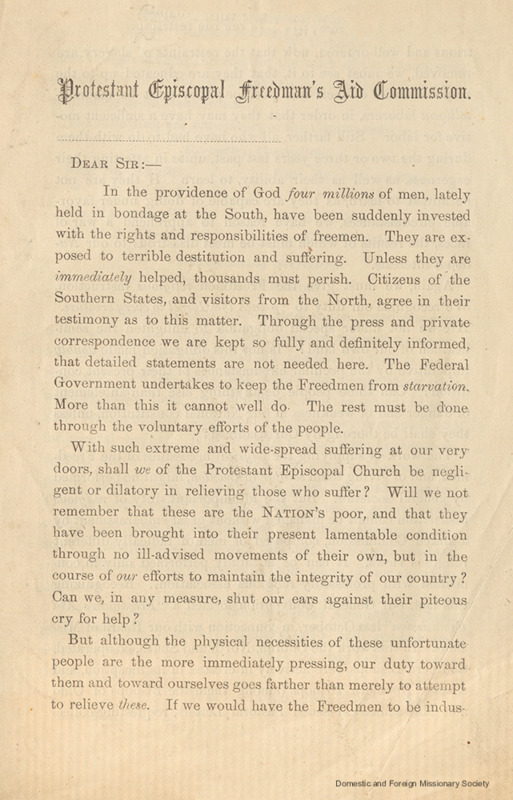
Protestant Episcopal Freedman's Aid Commission Circular, undated. Read the full document.
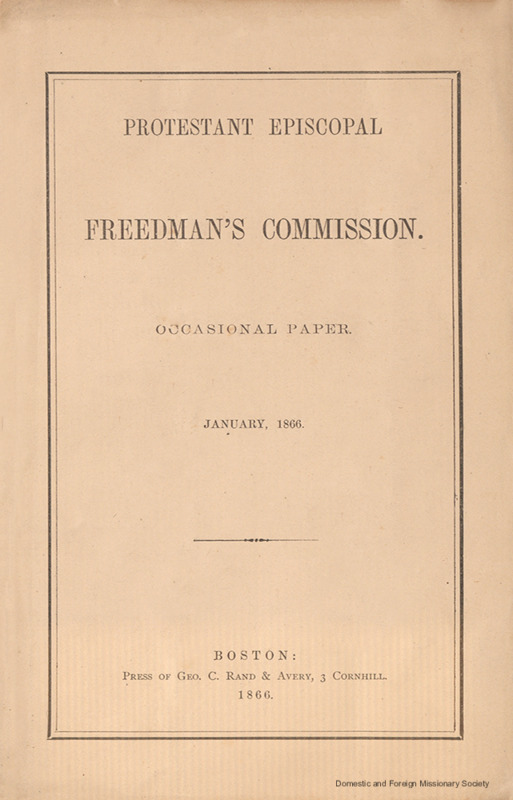
Protestant Episcopal Freedman's Commision Occasional Paper, January, 1866. Read the full document.