
The Right Reverend James Theodore Holly, 1829-1911
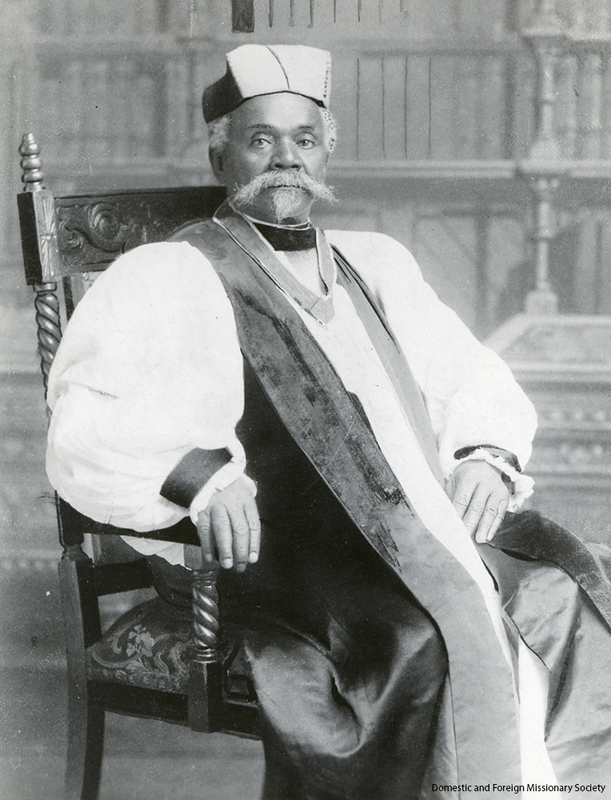
The Rt. Rev. James Theodore Holly of Haiti, the first Black bishop consecrated in The Episcopal Church, 1900.
Born in Washington, D.C., James Theodore Holly, a descendent of formerly enslaved individuals, was baptized and confirmed a Roman Catholic. His early years were spent in Washington, D.C. and Brooklyn, New York, where he connected with Frederick Douglass and other Black abolitionists. After a dispute over the ordination of Black clergy, Holly left the Catholic Church and joined The Episcopal Church in 1851. As an Episcopalian, Holly attended the first National Emigration Convention as a delegate and was selected commissioner for the newly formed National Emigration Board. Under the auspices of this office, he traveled to Haiti to negotiate an emigration treaty. While there, he explored the possibility of establishing a mission for The Episcopal Church. Upon Holly’s return to the United States, he requested that he be sent to Haiti to serve as a missionary, a request denied by the Board of Missions of The Episcopal Church.
In 1856, Holly was ordained a priest in New Haven, Connecticut. That same year he co-founded the Protestant Episcopal Society for Promoting the Extension of the Church Among Colored People, which challenged the church to take a position at General Convention against the institution of slavery. Holly served as rector at St Luke’s Church in New Haven, Connecticut until 1861 during which time he traveled and extolled the benefits of emigration to Haiti, a country where enslaved people had led a successful revolt and overthrown their European forces. He viewed Haiti as an opportunity for Black people to bind together and establish a Black nation in the Western hemisphere. He believed that bringing Anglicanism to Haiti would help to stabilize and develop the country more expeditiously.
In 1861, Holly led a group of 110 people to Haiti. Many in the group were congregants of St. Luke’s and subscribed to Holly’s vision for the country. Despite the obstacles, they succeeded in the establishment of a mission in Haiti. Disease and poor living conditions plagued the settlers, prompting many of them to return to the United States. Holly remained with only the most dedicated followers to establish schools, a church, and programs in pastoral training and countryside medicine.
It was not until 1865 and after many denied requests, that Holly received limited sponsorship from the Board of Missions for his work in Haiti. After serving as consul for Liberia at Port-au-Prince from 1864 to1874, Holly was consecrated missionary bishop to Haiti at Grace Episcopal Church in New York City, becoming the first Black bishop in The Episcopal Church.
As bishop, Holly served as a delegate to the Lambeth Conference in England, and received a doctoral degree from Howard University and an honorary law degree from Liberia College, Monrovia. He continued to live and work in Haiti, returning rarely to the United States, until his death in 1911.