
The Reverend Canon Frederick Boyd Williams, 1939-2006
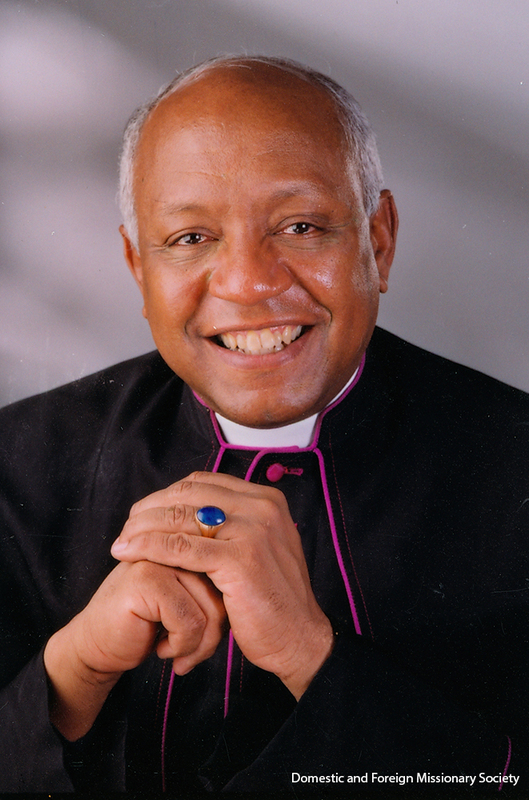
The Reverend Canon Frederick Boyd Williams strongly advocated for civil rights and social justice in the United States and abroad, 1998.
Frederick Boyd Williams was born in Chattanooga, Tennessee on April 23, 1939. He showed an early aptitude for mathematics and was admitted at age 15 to Morehouse College in Atlanta, Georgia, where he received his Bachelor of Arts degree in 1959. Upon graduation, he briefly worked as a research mathematician for NASA before matriculating as a postulant at General Theological Seminary in 1960, from where earned his Bachelor's of Sacred Theology.
After his ordination as a deacon on June 29, 1963, Williams began his curacy at St. Luke’s Church in Washington, D.C., where he also assisted in prison ministry. On January 11, 1964 he was ordained to the priesthood. Two years later, Williams was called to serve as Vicar of St. Clement’s Church in Inkster, Michigan, which was established as a Black mission of the Diocese of Michigan in 1936. He became its first rector in 1967. During his tenure in Michigan, Williams continued to develop his skills as an effective leader and became more active in the growing movement to honor the contributions and legacy of Blacks within The Episcopal Church. He was one of several prominent Black church leaders present at the organization of the Union of Black Clergy and Laity of the Episcopal Church (UBCL), the forerunner to the Union of Black Episcopalians, and served as its president from 1969 to 1971. He served the Diocese of Michigan in several leadership positions, including as a member of the Standing Commission and as a deputy to the 1970 General Convention.
In 1972, Williams was one of twenty scholars selected for the Martin Luther King, Jr. Fellows Program. The Fellows program included intensive research on the African Diaspora, which allowed Williams to travel to West Africa and the Caribbean. As part of the program, Williams completed his doctoral thesis entitled, “The Black Church and the Politics of Futurism” and received his Doctor of Ministry degree from the Colgate Rochester Divinity School in Rochester, New York in 1975. He was a noted scholar of the African Diaspora and a prominent advocate within the church for many liberation and justice movements in Africa, later founding the International Afro-Anglican Conference. In recognition of his advocacy for Africa, he was made an honorary canon of Holy Cross Cathedral, Gaborone, Botswana in 1979.
In 1973, Williams became the Vicar for the Church of the Intercession, a prominent part of religious and cultural life in Harlem, New York. Williams became its first Black rector in 1976, the same year that the congregation became an independent parish of the Diocese of New York, and remained in that role until his retirement as Pastor Emeritus in 2005.
While in Harlem, Williams responded directly to many of the problems and changing needs of the community over the course of his long ministry. He founded and served as Chairman of the Harlem Congregations for Community Improvement, Inc., an interfaith, ecumenical association of over 90 congregations. This organization completed the largest redevelopment project in the history of New York City when it successfully developed or rehabilitated over 2,000 housing units and commercial spaces in Harlem. He served for 10 years as Chair of the National Clergy Advisory Committee of the Harlem Week of Prayer, also known as the Balm of Gilead, Inc.
As a prominent proponent for civil rights and the religious inclusion of gays and lesbians, Williams initiated one of the first ministries to address the HIV-AIDS epidemic. In 1985, he invited fifty Black ministers to a conference on AIDS at the Church of the Intercession. While only 15 ministers attended this first conference, this was a crucial beginning to break a taboo subject in the Black community. Williams continued to advocate for a greater response to the AIDS crisis among the Black religious community and served as a member of the New York City Black Leadership Commission on AIDS.
Williams expanded his ministry to serve a variety of community and arts organizations. He was selected as a Trustee of the Rockefeller Foundation and was a member of the Board of Advisors of the New York City Landmarks Conservancy. Described as a true “Patron of the Arts,” Williams was active supporter of many major Black performing arts groups in New York City and was instrumental in providing the first home for the Harlem Boys Choir at the Church of the Intercession. In recognition of his generous service, Queen Elizabeth II named Canon Williams to the Most Venerable Order of St. John of Jerusalem.