
Jonathan Daniels, 1939-1965
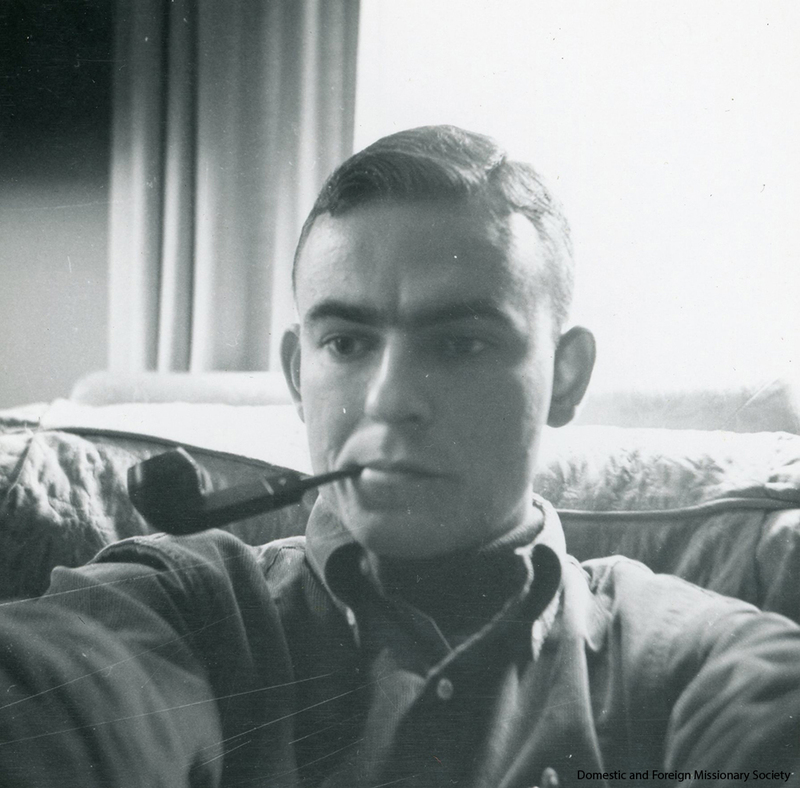
Jonathan Daniels, c. 1965.
Jonathan Daniels was born on March 20, 1939 in Keene, New Hampshire, into a Congregationalist family, although his mother’s family was Episcopalian. He was raised in Keene for much of his childhood and young adulthood, spending only a brief time as a young child in Arkansas, Kentucky, and Washington, D.C. when his family relocated as part of his father’s wartime service in the United States Army. The son of Latin teacher and a prominent doctor, Daniels was initially a rebellious and indifferent student; however, he became much more studious and serious after falling off a roof while sneaking home after a night cruising the town in a friend’s new car.
Upon graduating high school in 1957, Daniels entered Virginia Military Institute (VMI), drawn to its discipline and formality. A year later, he was confirmed in The Episcopal Church, the formal rituals of which he appreciated over the plainer Congregationalist meetings of his youth. Despite the challenges of a military academy, and the cultural differences between him and his Southern classmates, Daniels graduated as valedictorian in 1961. The position of valedictorian at VMI was not merely an academic one; Daniels was elected by his peers, who respected his honesty and forthrightness.
Daniels next pursued graduate studies in English literature at Harvard University, but became swiftly disenchanted with the program, which was likely exacerbated by his grief over his father’s death and his family’s ensuing financial struggles. Harvard was equally disenchanted with his struggling performance, and he left the university after only a year. Instead, he applied to the Episcopal Theological Seminary (ETS), also in Cambridge, which he entered in the fall of 1963.
ETS provided Daniels first adult introduction to the experiences of Black people in America as he was assigned to serve in an urban community in Providence, Rhode Island. He initially worked in an ecumenical arts program for underprivileged children; the following year he established a drop-in program for teens. This program was so popular that the church house floor required reinforcement to support the weight of the gathering.
In March 1965, Daniels and fellow seminarian Judy Upham, traveled to Selma, Alabama, to support Dr. Martin Luther King, Jr.’s actions for civil rights. In Selma, Daniels and Upham joined the marchers at the “Berlin Rope,” a rope stretched across the street near Brown Chapel and reinforced by a line of police officers to keep the marchers in the Black neighborhood. With the other protestors, Daniels and Upham held vigil there, sleeping in the street even in the rain.
Viewing their work in Selma as too critical to abandon, Daniels and Upham petitioned ETS to allow them to remain for the semester. The seminary agreed that they could remain and complete their coursework by correspondence, returning only for final exams. While in Selma, the pair lived with the West family in the George Washington Carver housing project and worked tirelessly to integrate St. Paul’s Episcopal Church, which was viewed by diocesan leadership as extremely conservative, bordering on reactionary. Although they had some success in bringing integrated groups to services, the overall attitude of the vestry and parishioners remained unwelcoming.
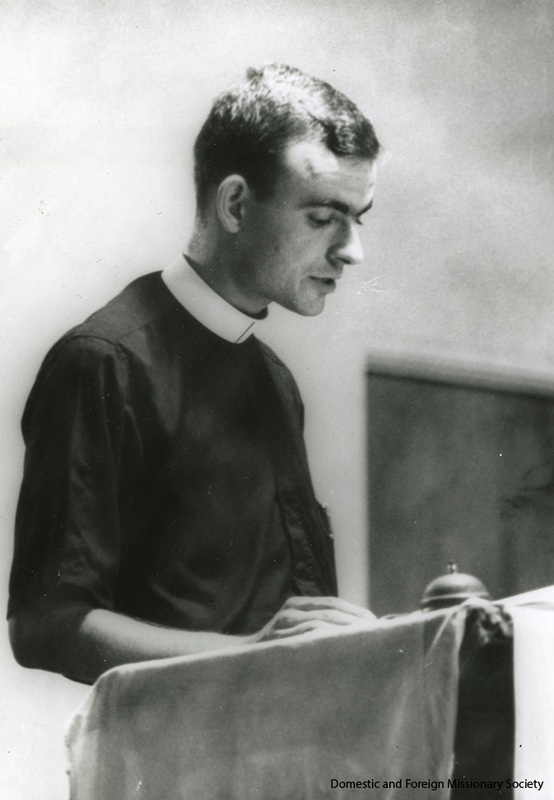
Jonathan Daniels, undated.
After final exams in mid-May, Daniels returned to Selma as a representative of the Episcopal Society for Cultural and Racial Unity (ESCRU). Working alongside civil rights workers from the Student Nonviolent Coordinating Committee (SNCC), Daniels registered voters and provided Black community members with information on available social services, such as health clinics. Additionally, he lobbied local hospital administrators to increase the number of beds available for Black patients. By July, however, he turned his attention to civil rights efforts in “bloody Lowndes,” a stronghold of white supremacy and racial violence.
The white residents of Lowndes county maintained absolute control over the economy and politics of their community that predated the Civil War. Despite the ruling of Brown v. the Board of Education in 1954, Lowndes schools were still strictly segregated in 1965. And although there were six thousand eligible Black residents, in January 1965 there was not a single Black registered voter.
In 1965, Black civil rights organizers began work to address segregation and voting rights in Lowndes county. Daniels was their first white volunteer. Although the community organizers believed the Lowndes civil rights initiative should be Black-led and Black-run, they were impressed enough by Daniels’ demeanor to allow him to work with them on an unofficial basis. During these efforts, Daniels was shot and killed.
Daniels’ body lay in state at St. James’ Episcopal Church in Keene, New Hampshire before his burial. At his funeral, his theology professor, William J. Wolf, read from Daniels’ paper “Theological Reflections on My Experience in Selma.” In it he wrote, “I lost fear ... when I began to know in my bones and sinews that I had truly been baptized into the Lord’s Death and Resurrection, that in the only sense that really matters I am already dead, and my life is hit with Christ in God.”
At the urging of the Reverends John Morris, Henri Stines, and others, Jonathan Daniels was added to the Calendar of the Church year by a unanimous vote of both houses at the 1991 General Convention. He is remembered on August 14, the day of his arrest with other civil rights workers in Hayneville, Alabama.