
The Right Reverend Michael Bruce Curry, 1953-
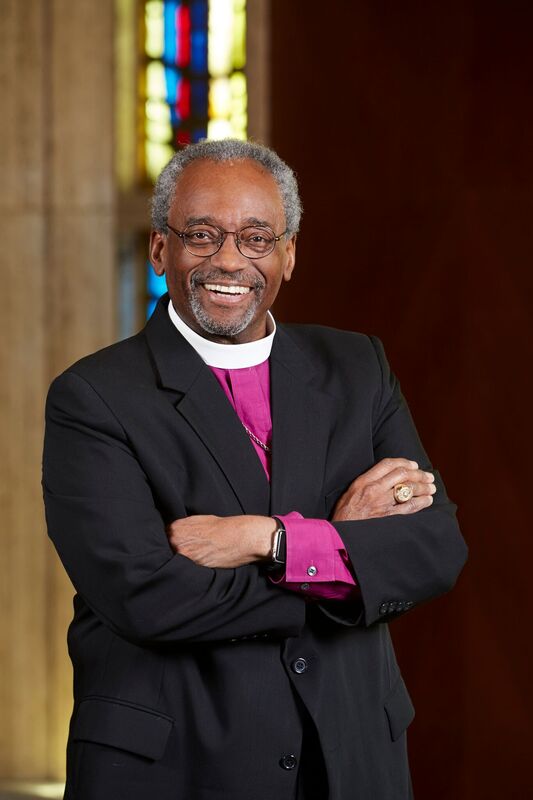
Bishop Michael Curry, the first Black Presiding Bishop of The Episcopal Church.
Michael Bruce Curry, the first Black Presiding Bishop of The Episcopal Church, was born in Chicago, Illinois, in 1953, to the Rev. Kenneth and Mrs. Dorothy Curry. His father, born a Baptist and raised in Ohio, joined The Episcopal Church in the late 1940s after attending Eucharist with Dorothy, who was an Episcopalian. Southern Ohio was still starkly segregated at that time; seeing the entire congregation sharing the same communion cup without regard to race impressed him deeply. Kenneth became an Episcopal priest in 1953. In 1956, he became rector of St. Philip's in Buffalo, New York, where the couple raised their children to be active both in the Episcopal faith and in the struggle for civil rights.
Michael Curry graduated from Hobart College in 1975 with high honors and earned his Masters of Divinity from Yale Divinity School in 1978. In June of that same year, he was ordained a deacon. He was elevated to the priesthood in December by the church’s first Black diocesan bishop, John Burgess of Massachusetts. From 1978 to 1982, he was rector of St. Stephen’s Episcopal Church in Winston-Salem, North Carolina. In 1982, he was called to be rector of St. Simon of Cyrene in Cincinnati, Ohio, where he served until 1988, while also acting as Chaplain at the Bethany School beginning in 1984.
In 1988, Curry became the rector of the third oldest historically Black parish in the country, St. James in Baltimore, Maryland, where he stayed until 2000. In an interview with the New York Times, Curry credited his time at St. James, which coincided with the AIDS crisis, for the growth of his understanding of “the interconnections between [...] patterns of exclusion across a lot of different lines – race, gender, class.”
Having grown up in the Civil Rights era, Curry's work was grounded in the words of his father, “God didn’t make anybody to be a second-class citizen. Of this country, or the human family.” Eliminating barriers to inclusion was a central focus of Curry’s ministry. As Bishop of North Carolina, to which he was consecrated in February 2000, Curry was known nationally as a strong proponent of LGBTQ+ rights and an advocate for racial reconciliation. He refused to condemn those who disagreed with him, including members of the Anglican Communion who voted to sanction The Episcopal Church over its decision to bless same-sex marriages, holding the belief that “this love of God is big enough to embrace all of us, and even embrace us in our disagreements.”
After the 2015 General Convention elected him Presiding Bishop, Curry called for the church to transform itself into “the Episcopal branch of the Jesus Movement.” The phrase captures a desire to strip away divisive and sectarian ideas and return the focus of Episcopal believers to the living example of Jesus, “seeking every day to love God with our whole heart, mind and soul, and to love our neighbors as ourselves.” The church embraced three unifying priorities of the Jesus Movement: evangelism, care of creation, and reconciliation. As Bishop Curry stated, the goal of the Jesus Movement is to effect “reconciliation – beginning with racial reconciliation [...] across the borders and boundaries that divide the human family of God. This is difficult work. But we can do it. It’s about listening and sharing. It’s about God.”
Michael Curry is the author of Crazy Christians: A Call to Follow Jesus (2013) and Songs My Grandma Sang (2015).