
The Reverend Alexander Crummell, 1819-1898
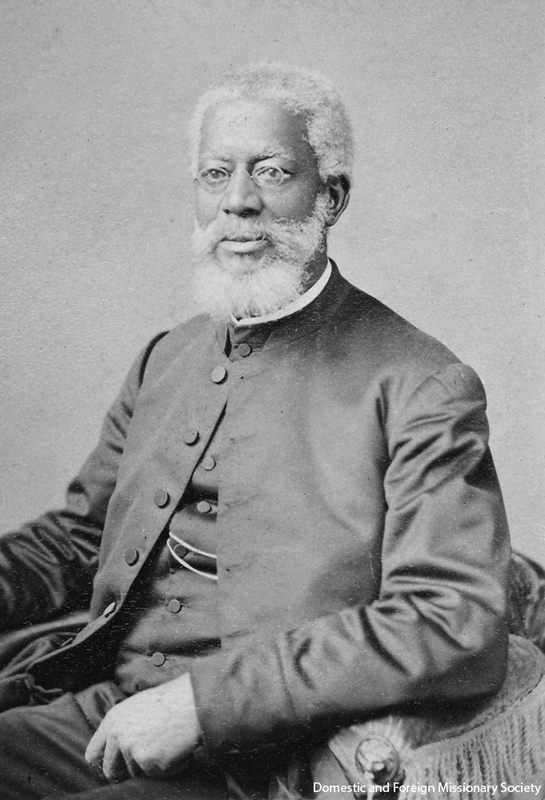
The Reverend Alexander Crummell, abolitionist and founder of the Conference of Church Workers Among Colored People (CCWACP), 1877.
Born in New York City in 1819, the grandson of a West African chief and the son of a free mother, Alexander Crummell attended the Quaker-operated New York African School as a young man. Among his classmates were other future Black leaders Henry Highland Garnet, Ira Aldridge, and Samuel Ringgold Ward.
Due to his race, Crummell was denied entrance to General Theological Seminary. Despite this setback, he received his theological education in the Diocese of Massachusetts. In 1842, he was ordained to the diaconate, and two years later to the priesthood, by the Bishop of Delaware. In 1844, he established a small mission in Philadelphia. There he became involved in politics, including the campaign for equal suffrage and the abolition of slavery. After being excluded from the Pennsylvania diocesan convention, Crummel left the diocese and moved to England in 1848 where he graduated from Queen’s College, Cambridge in 1853.
As an early advocate of the colonization of Liberia, Crummell went to Africa in 1853 as a missionary and served at four parishes and on the faculty of Liberia College. Crummell believed African Americans needed a moral and spiritual revival and viewed Liberia as the place to create a model Christian republic with The Episcopal Church providing a moral and rational discipline. During visits to the United States, he advocated for Black emigration to Africa and for African self-help.
In 1873, after running into opposition and indifference in Liberia, Crummell settled in Washington, D.C. and became “missionary at large to the colored people.” He focused on founding and strengthening urban Black congregations that provided worship, education, and social services for their communities. In 1883, when the Southern Bishops proposed that all Black congregations become separate missionary districts, Crummell organized the Conference of Church Workers Among the Colored People (succeeded by the Union of Black Episcopalians) in protest. In 1897, he founded the American Negro Academy, America’s first major Black scholarly society.
A prolific writer, Crummell published articles, sermons, and three books: The Future of Africa: Being Addresses, Sermons, etc. Delivered in the Republic of Liberia (1862); The Greatness of Christ and Other Sermons (1882); and Africa and America: Addresses and Discourses (1891). He continued his campaign against racial oppression and the promotion African American leadership until his death in 1898.
His personal papers are located at the Schomburg Center for Research in Black Culture, in New York.