
Anna Julia Haywood Cooper, 1858-1964
The colored woman feels that woman's cause is one and universal; and that not till the image of God,
whether in parian or ebony, is sacred and inviolable; not till race, color, sex, and condition are seen as
the accidents, and not the substance of life; not till the universal title of humanity to life, liberty,
and the pursuit of happiness is conceded to be inalienable to all; not till then is woman's lesson taught
and woman's cause won--not the white woman's, nor the black woman's, nor the red woman's,
but the cause of every man and of every woman who has writhed silently under a mighty wrong.
- Anna Julia Haywood Cooper
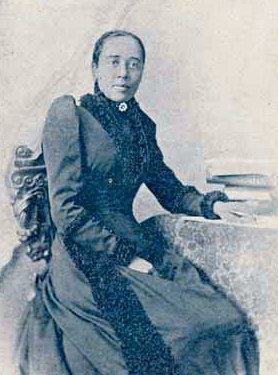
From A Voice from the South, Cooper's 1892 book. Print courtesy of UNC and "Documenting the American South" project.
Anna Julia Haywood Cooper, Episcopal educator and author, was born on August 10, 1858, in Raleigh, North Carolina. Her mother, Hannah Stanley Haywood, was an enslaved person. As her mother refused to discuss the matter, Anna's paternity was never fully determined, but she believed her father to have been either her mother's enslaver, Dr. Fabius J. Haywood, Sr. or his brother George.
Anna enrolled in the newly established St. Augustine's Normal and Collegiate Institute, where, at the age of nine, she first embraced the Episcopal faith. By the time she was eleven years old, her math and language abilities had earned her the position of "scholarship-teacher," which paid a stipend of $100 a year in exchange for tutoring other students. Cooper spent fourteen years at St. Augustine's, staying on as a matron after she graduated. She remembered her time there fondly, in spite of the institutional prejudice against women. She overcame the institution’s exclusion of women from Greek language classes to become the first woman at the school to study Greek.
In 1877, while still working at St. Augustine's, she married George Cooper, a minister and professor of Greek from Nassau, British West Indies. George died two years later, leaving Anna a widow at the age of twenty-one. She never remarried, but instead devoted her life to academics, education, and the pursuit of social justice. In 1881, she left St. Augustine's and moved north to Ohio, where she attended Oberlin College, one of the first American colleges to admit both Black and white students. Because of her impressive array of academic achievements at St. Augustine's, she was admitted as a sophomore. At the time Oberlin offered two courses of study: a traditionally rigorous course for "gentlemen" and a two year course designed to provide "ladies" with a basic but inferior college education. Cooper opted to pursue the Gentleman's course, and earned her Bachelor of Arts in 1884. She was awarded an honorary Master of Arts by Oberlin in 1887.
Upon receiving her Master's degree, Cooper accepted the post of math and science teacher at Washington High School in Washington, D.C., a prestigious preparatory school for Black students. Washington High School was later known as the M Street School, then the Dunbar School. Cooper spent the majority of her career at Dunbar, beginning her employment in 1887. In 1902, she was appointed principal of the school. Her philosophy on education for Black students differed significantly from that of other leading Black educators, notably Booker T. Washington, who was friendly with Cooper's predecessor as principal, the superintendent of the district, and the man who replaced her in her position. Washington held that the best way to advance the Black community lay in vocational education, while Cooper felt strongly that all students, regardless of race or gender, deserved the opportunity to receive a college education. To that end, she spent her time as principal of M Street enhancing the vocational programs with the addition of a strong college preparatory program, actively seeking college placement and scholarships for her students. The program was extremely successful, with students accepted into Harvard, Yale, and Brown, but in spite of this Cooper was asked to discontinue her non-vocational approach and to adopt inferior textbooks for her students. When she refused, she was forced to resign.
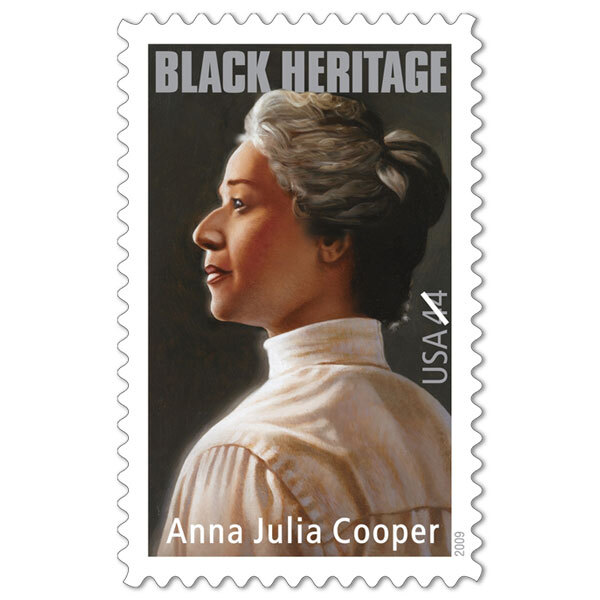
Anna Julia Cooper is the 32nd person commemorated on a postage stamp in the U.S. Postal Service's "Black Heritage Series," June, 2009. Image courtesy of the United States Postal Service.
After her departure, Cooper taught language at the Lincoln Institute in Jefferson, Missouri, for four years while contesting her removal from M Street. In 1910, she was rehired at M Street as a Latin teacher, a position she held for the next twenty years. While teaching, Cooper continued to further her own education. She spent the summers of 1911 to 1913 in France at the Guilde Internationale de Paris, where she studied French history, literature, and linguistics.
In 1914, Columbia University in New York accepted Cooper as a doctoral candidate. A year later, at the age of 57, she adopted her nephew’s five orphaned children, who ranged in age from six months to twelve years old, and expended a great deal of effort moving into a larger house to "contain their Southern exuberance." On evenings and weekends, she completed the course work for her doctorate degree. However, to grant the degree, Columbia required a year's residency, which Cooper was unable to fulfill because of her other responsibilities. She transferred to the Sorbonne, where she was granted her doctorate at the age of 65.
When she retired from M Street School, renamed Dunbar, in 1930 at the age of 72, she became president of Frelinghuysen University, an institution offering education for older, employed Black students. Founded in 1906 as a way for Black people to improve their lives and expand their opportunities, Frelinghuysen offered both vocational and academic training. Cooper was a strong supporter of the Frelinghuysen ideal of self-help; the school was an entirely self-supported Black enterprise. Cooper offered her home as a classroom when the University needed a permanent location, and after her presidency, she stayed for a further ten years as the registrar.
Cooper was concerned with racial and gender equality throughout her life and devoted her energies to writing and speaking extensively on her belief in empowerment through education. She participated in conferences on racial and gender equality and education, including the World's Congress of Representative Women at the Chicago World's Fair in 1893, the Woman Suffrage Congress in 1893, and the Pan-African Conference in London in 1900. She was also the first woman to become a member of the American Negro Academy, an intellectual organization founded by the Rev. Alexander Crummell, an Episcopal priest, to further higher education and racial equality.
Cooper's publications include her Columbia doctoral thesis, a translation into modern French of Le Pelerinage de Charlemagne, an eleventh century French epic, which was used as a college text; her thesis from the Sorbonne, a work examining the racial attitudes of the French revolutionaries towards their Caribbean colonies; and several compilations of essays and speeches, among which the most widely known work is A Voice from the South, by a Black Woman from the South, published in 1892.