
Conservative Reaction
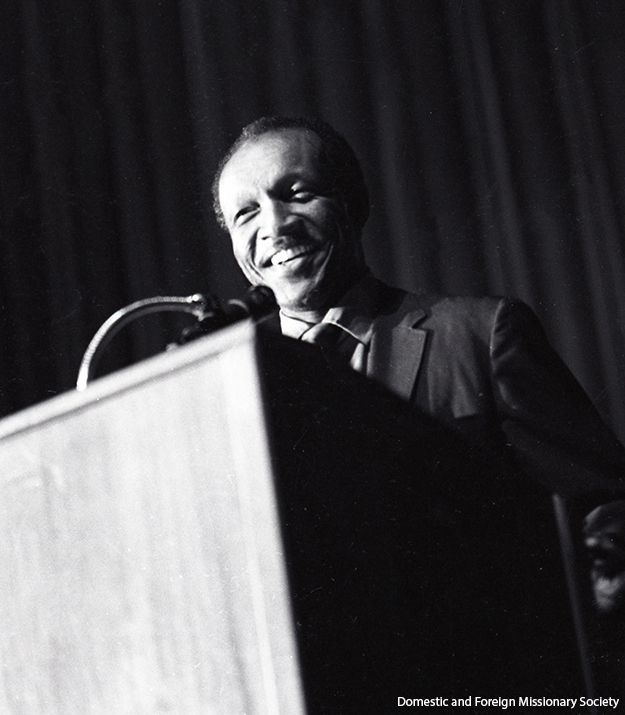
Leon Modeste speaking at the 63rd General Convention in Houston, Texas, 1970.
Moving the church’s financial assets from institutional sustenance to social purposes was a risky challenge to orthodoxy. Between 1967 and 1969, Bishop Hines and the General Convention Special Program (GCSP) staff, headed by program director Leon Modeste, faced mounting criticism from conservative church members who feared funds might be misused or sent to groups advocating violence. Grants were awarded by Executive Council without the approval of diocesan bishops, who proposed they ought to have veto privileges should they disapprove of an applicant or at least be told of applications by organizations in their dioceses. Furthermore, Hines and the Executive Council made a mistake common to white leaders in the church, which was to ignore the experience, history, and knowledge of Black clergy in favor of tapping “outsiders” to force change. Black clergy resented their voices going unheard while the GCSP funded non-Episcopal organizations.
The Executive Council did its best to address these concerns. It emphasized in its report to the 1969 Special General Convention that, although the church had no direct control over how organizations used the grant money, it was by no means money “for indiscriminate use by the Presiding Bishop.” Grants were based on the principle of self-determination, but they were made based on an organization’s ability to meet specific criteria, such as non-violence, semi-annual financial accounting, and an annual evaluation of the program’s administration, execution, and progress. An evaluation presented to the 1970 General Convention indicated that the program worked well as designed. The polarization in the church was more a reflection of the larger society than a result of the GCSP.
LISTEN
Leon Modeste, the Director of the General Convention Special Program, maintains that integration is not a possibility in the near future, and discusses the GCSP's role and methods in improving the situation, 1968.