
Confrontation
“The decision by the Black Economic Development Conference to attempt to seize the microphone, to get the platform, to interrupt the proceedings and interject something real and relevant into the discussion, that decision was a labored decision. It was a hard thought-out decision. What did happen was that after we made that move, Black clergyman, Black delegates, and a large number of youth delegates and non-delegates were emotionally moved to pull-in with us.”
- Muhammad Kenyatta
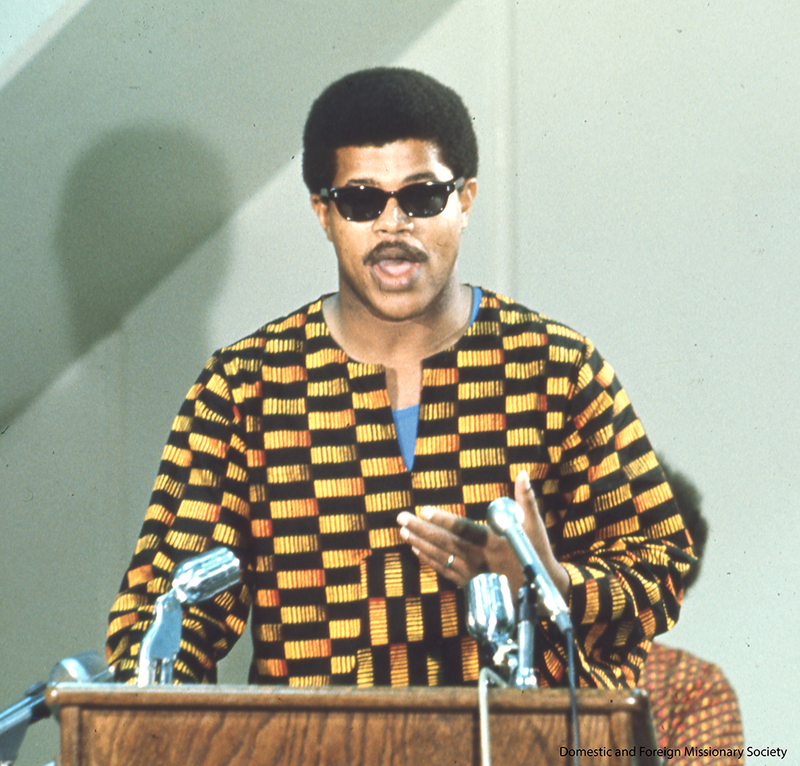
Civil rights activist Muhammad Kenyatta speaks at the General Convention Special Program, 1969.
“General Convention II,” as the anomalous 1969 Special General Convention was also known, was an unusual event in the church’s history. Only one other General Convention, that of 1821, had been called outside of the regular triennial period. Nevertheless, it was a moment of self-recognition in which t church confronted its place in public life and tested the theological understanding of the baptismal covenant and the true meaning of catholicity in the diversity of God’s creation.
The Convention was called to order on August 31, 1969, in South Bend, Indiana amid tumult in the church over the General Convention Special Program (GCSP) and the Black Manifesto. In his opening sermon to the delegates, Bishop Hines called for a renewed commitment to social justice, “a more comprehensive justice than that which [the church’s] whiteness is inclined to try to dictate,” and a “willingness to listen” to different opinions in the church. This call was tested at a non-legislative Joint Session when members of the Union of Black Clergy and Laity (UBCL) ascended the platform with Rev. Muhammad Kenyatta, a Philadelphia Baptist and representative of the Black Economic Development Conference (BDEC). According to The Witness, Kenyatta and Hines “tussled briefly” over the microphone before Hines asked the delegates if they would give Kenyatta a chance to speak. Although some delegates protested in a confused round of voting, the “ayes” had it.
Kenyatta called upon the Convention to make racial injustice and reparations its dominant issue. Further, he asked the General Convention to donate to $200,000 to BEDC. While Convention was willing to acknowledge its “commitment to the principle of self-determination for minority groups” and that the BEDC was one such group, it did not resolve to give the organization money. Instead, it resolved to raise $200,000 in extra-budgetary funds to grant to the National Committee of Black Churchmen (NCBC), an ecumenical group advocating for Black empowerment, for national Black community development. Individuals, parishes, and dioceses ultimately raised $225,167 for the NCBC in response to the resolution, which was a compromise between parties wanting to answer Kenyatta’s call and those who were unwilling to fund BEDC. Rev. J. Metz Rollins, a Presbyterian NCBC member, told the Executive Council that the organization “will serve as a conduit for funds if it is necessary but will do it reluctantly. It’s your problem, not ours.” It was necessary. Executive Council resolved to designate the funds for the NCBC. The principal recipient was BEDC.
This allocation of funds sparked controversy within the church and an investigation by a United States Federal Grand Jury into whether or not Kenyatta coerced deputies into voting for the $200,000 donation; Hines considered the whole matter “a tempest in a teapot.” Critics of the Convention’s financial commitment interpreted the decision as the church’s acceptance of the Black Manifesto and BEDC’s demands for reparations; however, Hines remained adamant that the church was neither politically far-left nor politically far-right. To the delegates of the Diocese of Missouri Convention on October 22, 1969, he said that the course General Convention II had chosen was “a sensitive, open course which [reflected] a humane, concerned ministry for minority groups.”
LISTEN
General Convention II, An audio recording of highlights from the Special General Convention, 1969.
General Convention Special Program, Presiding Bishop Hines discusses the General Convention Special Program and the Church’s response to racial crisis, 1970.
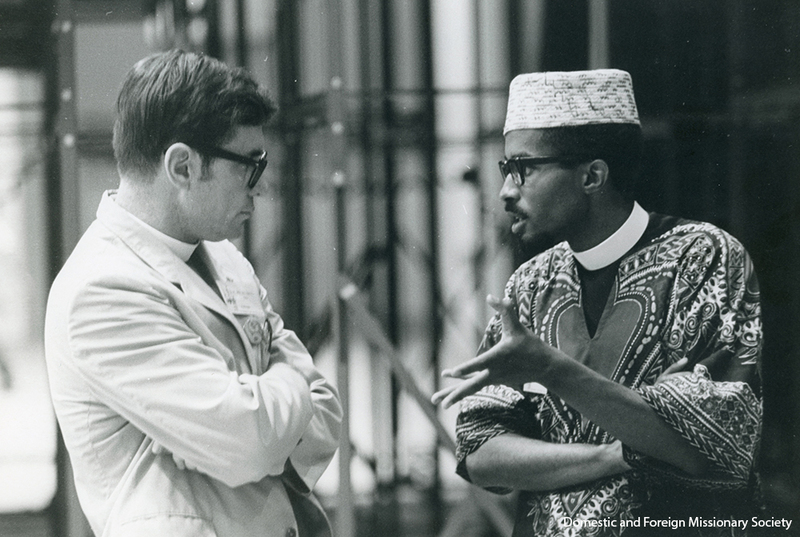
Bishop of Guatemala, Rt. Rev. William Frey speaks with Rev. Orris G. Walker Jr., the Episcopal Associate from St. Mark's Eccumenical Parish in Kansas City, MO, during the 1969 General Convention Special Program.
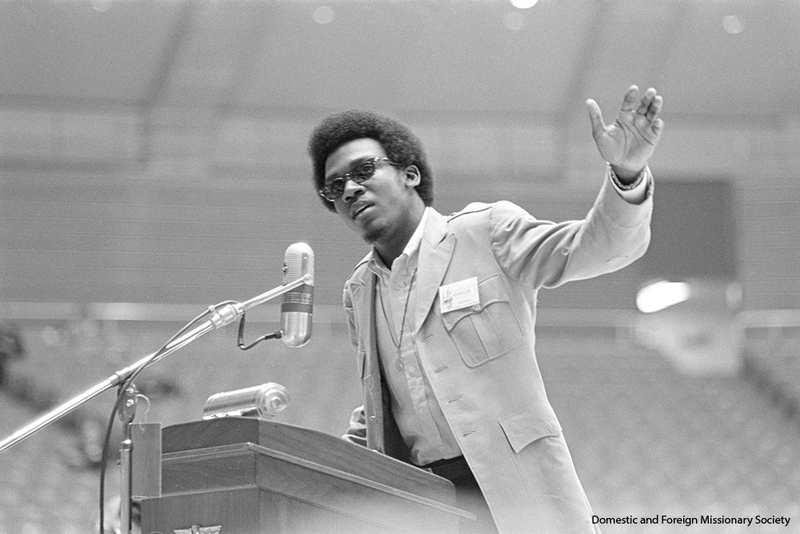
Youth representative speaking at the Special General Convention, 1969.
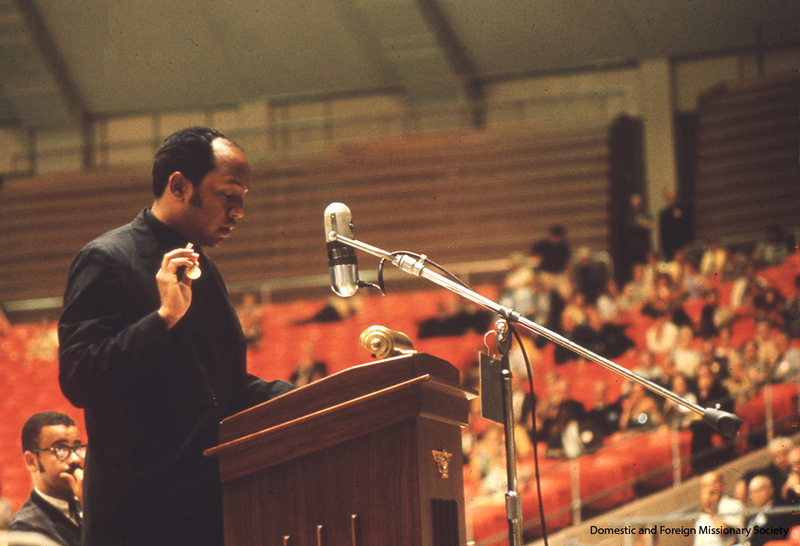
Rev. Frederick Williams speaks during the GCSP, 1969.
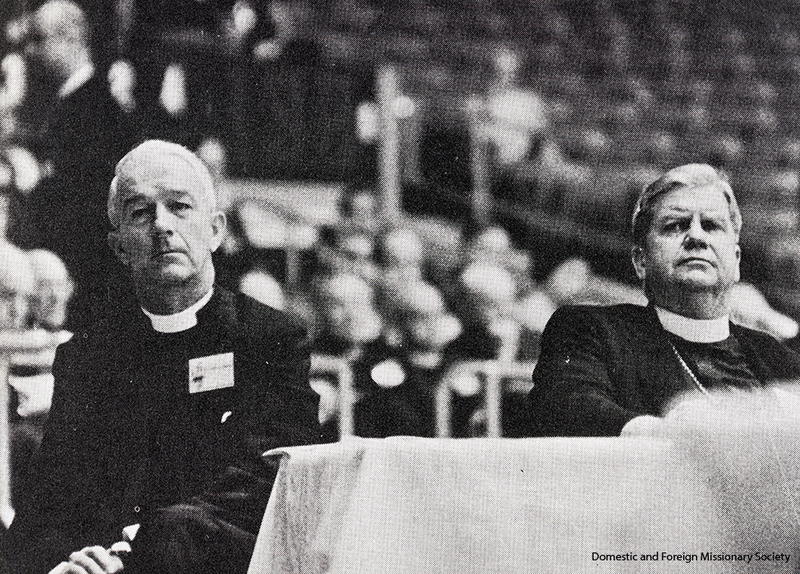
President of the House of Deputies, Rev. John Coburn is seated with Presiding Bishop John Hines during the 1969 General Convention Special Program.