
Church and City
"The life of The Episcopal Church is inextricably interwoven with the life of our cities. In the great cities of our land that church finds its greatest numerical strength. Its membership in those cities includes both many of those who are making basic decisions about the future of the city, and many of those who suffer from the decisions which are made. The church thus represents in its own membership the essence of the problem and the responsibility for solutions."
- Urban Bishops Coalition, To Hear and to Heed
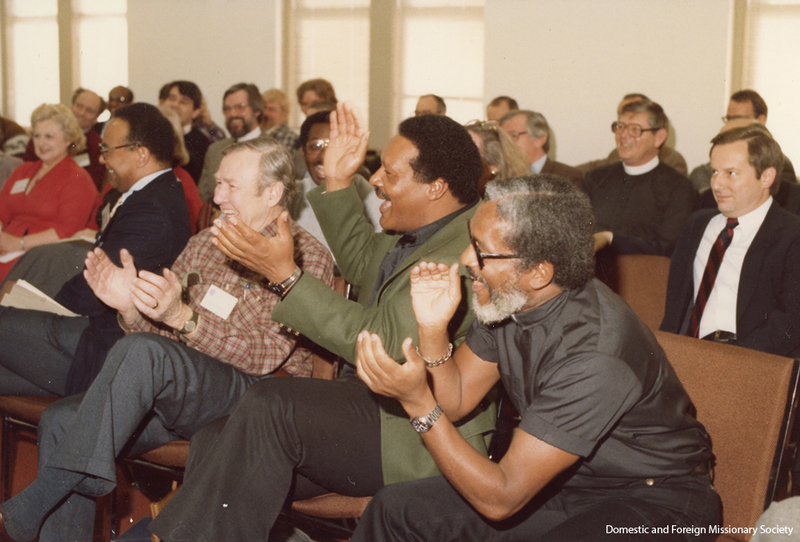
Attendees at the Church and City Conference held in Atlanta, Georgia in 1983.
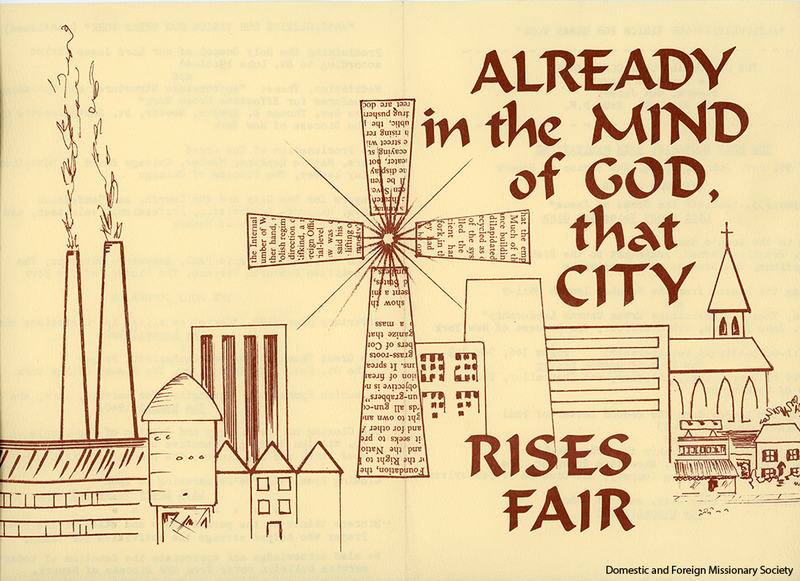
“Articulating our Vision for Urban Work,” a service booklet from the 1986 Church and City Conference.
Beginning with the Second World War and extending into the 1960s, the “Second Great Migration” of rural Black workers and families to northern cities created a new dynamic in race relations played out in the housing market. Middle-class white residents moved away from city centers to segregated suburban communities, leaving behind older housing stock and absentee landlords. Neighborhoods rapidly deteriorated in the 1950s and early 1960s as cities added public housing projects and urban renewal programs displaced Black communities, leading to further crowding. Urban Black neighborhoods that had once been vibrant pockets of community activity and commerce were transformed into poverty-stricken and crime-ridden slums with few jobs and failing schools and became known as “black ghettos” and “inner city” areas.
The urban demographic shift created a crisis in urban ministry. While dioceses planted new churches in suburban soil, they merged and closed the old inner city parishes. Urban clergy responded first, establishing the Church and City Conference in the 1950s to keep the church alive in urban areas. Through the Joint Urban Program, under the Home Department of the National Council, it sponsored training programs and “pilot dioceses” to educate the church about urban ministry in the early 1960s. However, the church continued struggling to operate in its traditional stronghold. In 1976, the bishops of major metropolitan areas created the Urban Bishops Coalition to address the plight of urban parishes.
Joining with the Church and City Conference, the Urban Bishops Coalition held a series of public hearings with the people who lived, worked, and struggled in America’s inner cities, providing them the opportunity to present their concerns to church leaders. The resulting report suggested a national entity be organized to strengthen the role of city parishes and to make a long-term commitment to urban issues. The result was the Episcopal Urban Caucus, which was formed in 1980 and continues as a proactive ministry in urban affairs and global concerns.
- "Profile of a Downtown Church", by the Very Rev. Lloyd E. Gessle, 1963.
- "Renewal of Church in the City", by Bishop Wesley Frensdorff of the Diocese of Nevada, 1980.
- "Ministry in the City, Post New Orleans", 1983.
- Prospectus for a National Assembly to Organize the Episcopal Urban Caucus
- Towards Formation of an Episcopal Urban Caucus by the Urban Bishops Coalition, undated.
- Deliberative Document Report from the Urban Bishops Coalition
- To Hear and To Heed: The Episcopal Church Listens and Acts in the City by the Urban Bishops Coalition, 1978.
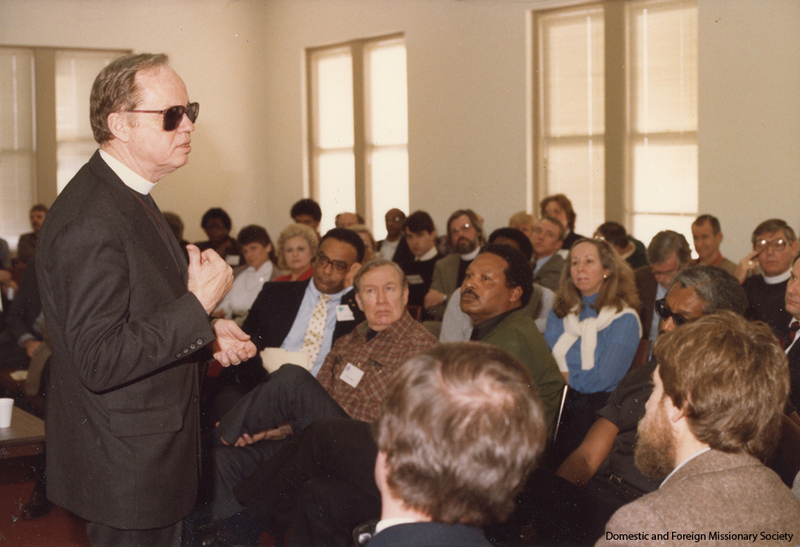
Presiding Bishop Allin speaking to attendees at the Church and City Conference held in Atlanta, Georgia in 1983.
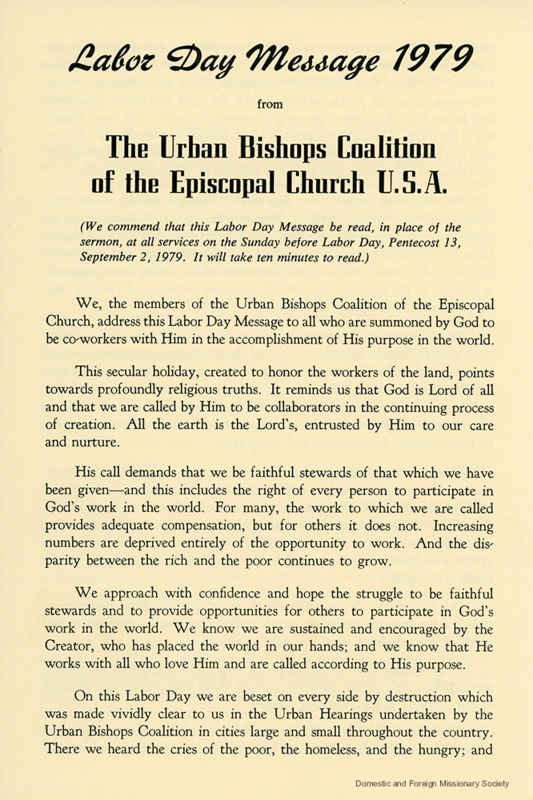
Labor Day Message from The Urban Bishops Coalition, 1979.
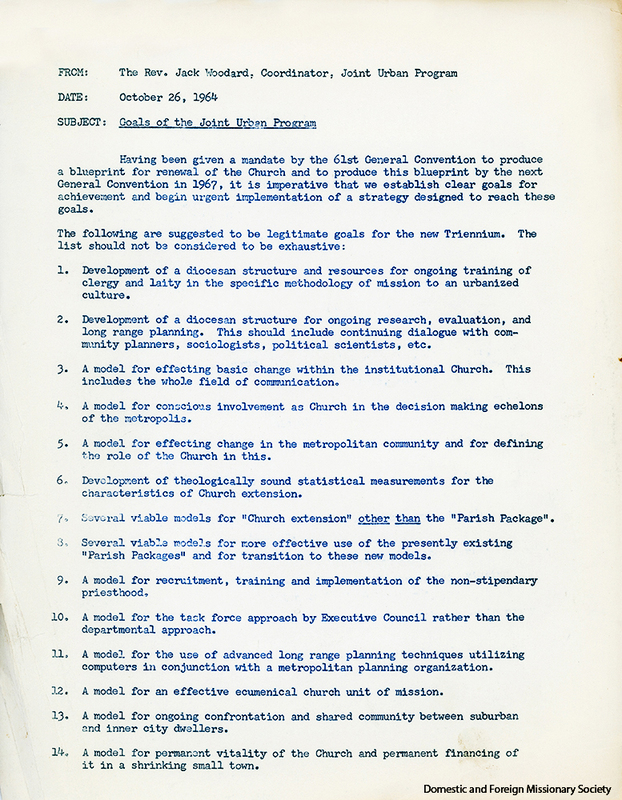
Goals of the Joint Urban Program, 1964.
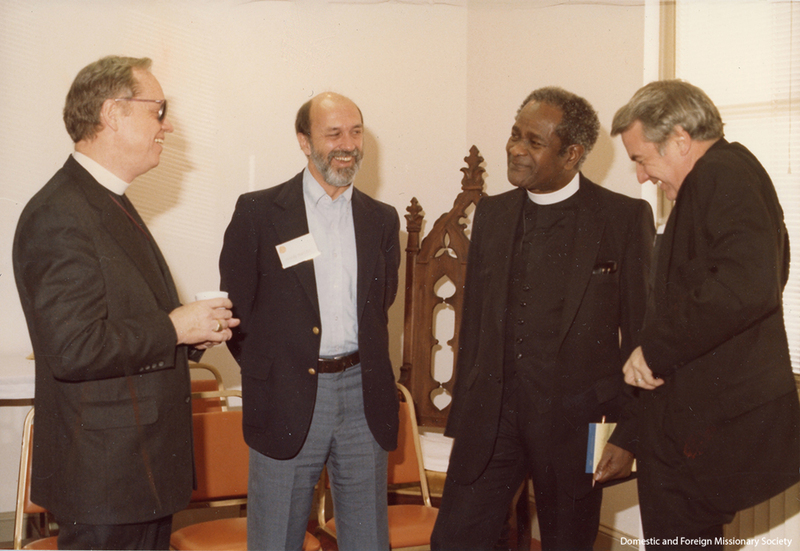
Attendees at the Church and City Conference held in Atlanta, Georgia in 1983.