
Black Manifesto
"We the black people...are fully aware that we have been forced to come together
because racist white America has exploited our resources, our minds, our bodies, our labor."
-The Black Manifesto
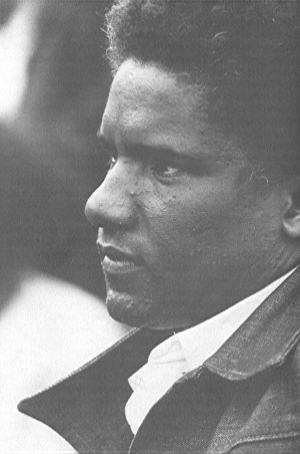
James Forman, author of the "Black Manifesto" and spokesman for the Black Economic Development Conference, 1969.
In 1967, the same year Bishop Hines conceived of the General Convention Special Program, a small interfaith group of religious leaders formed an organization with the goal of raising money from wealthy, white-dominated religious denominations for the support of Black community organizations. In addition to its ecumenical fundraising efforts, the International Foundation for Community Organization (IFCO) hosted a national conference on economic development in the Black community: the Black Economic Development Conference.
Meeting from April 25 to 27, 1969, in Detroit, Michigan, the Black Economic Development Conference drew roughly six hundred participants – two hundred more than the anticipated number – and encompassed interests from community to corporate; industrial to labor; radical to conservative; and urban to rural. The highlight of the conference, however, occurred on April 26, when James Forman, a Civil Rights activist and former Executive Secretary of the Student Nonviolent Coordinating Committee (SNCC), presented the “Black Manifesto.”
The Black Manifesto was a call for reparations from the white Christian churches and Jewish synagogues which, it argued, held tremendous wealth gained from the exploitation of Black people both within the United States and around the world. It suggested a starting sum of five hundred million dollars ($500,000,000), or fifteen dollars for each Black person in the United States. Among other projects the money would be used for the establishment of a Southern land bank; media industries; a training center for media communications; a Black university; and a National Black Labor Strike and Defense Fund.
At the conclusion of the Black Economic Development Conference, Forman established a separate organization with the same name, commonly known by its abbreviation “BEDC.” He then set out to lobby for reparations from white churches and synagogues. Only days later, Forman took his efforts to New York City, where many denominations and ecumenical organizations were headquartered. On May 13, 1969, he met with Presiding Bishop Hines and presented his demands for The Episcopal Church: Sixty million dollars and an additional sixty percent per year of the income from all of the church’s assets.
Responses from other denominations varied. The United Methodist Church rejected the Manifesto, but committed 1.3 million dollars to an internal program for the “economic empowerment of Black people.” Likewise, the United Presbyterian Church authorized fifty million dollars for internal programs addressing poverty. The Synagogue Council of American and National Jewish Community Relations Advisory Council, along with the American Baptist Convention, rejected the Manifesto, but pledged continued support for programs reducing inequality. And The Southern Baptist Convention, along with the Roman Catholic Archdioceses of New York and Cincinnati, rejected the Manifesto outright.
The Executive Council responded to this demand at their meeting a week later. Although the Council recognized the poverty and injustice extant in society, it voted to “not accept” the Manifesto. Instead, Executive Council pointed to The Episcopal Church’s ongoing programs to address poverty and injustice, including the budgeted nine million dollars for community organization grants, a million dollars in church funds deposited into over fifty Black-owned and operated banks across the United States, and three million dollars allocated for “ghetto enterprises.”
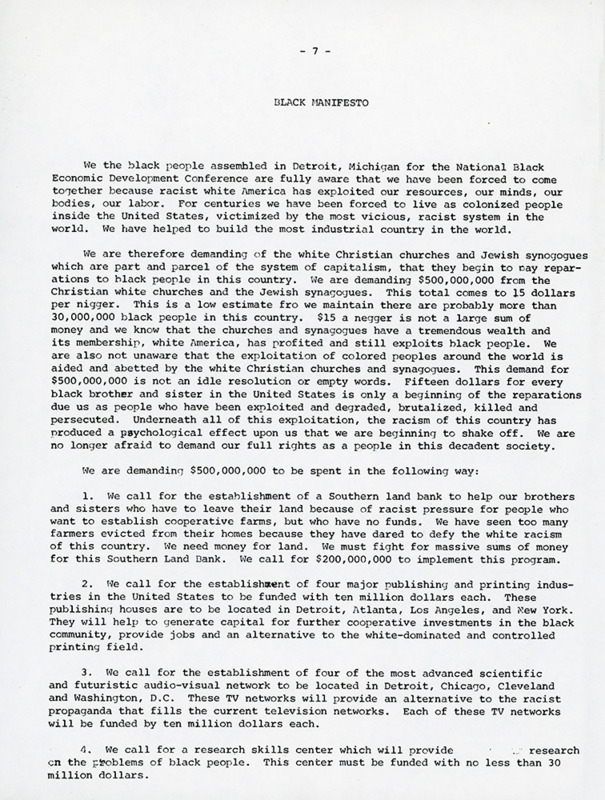
The Black Manifesto, the first major call for black reparations in the twentieth century, issued by the BEDC, April 26, 1969. Read the full document.
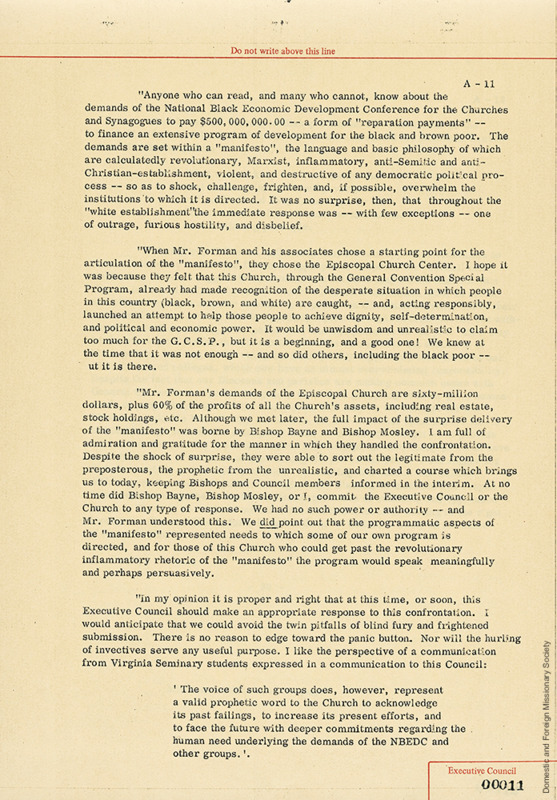
Executive Council’s Response to the Black Manifesto, May 1969.
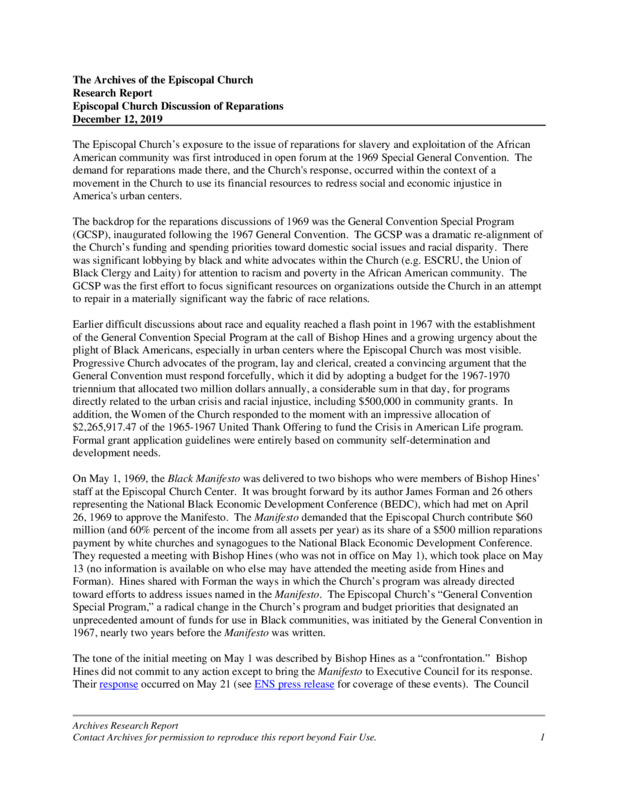
Archives Research Report on “The Question of Reparations to the African Americans,” 2005.
LISTEN
Muhammad Kenyatta, vice-chairman of the Black Economic Development Conference, explains why he believes that the Black Manifesto cannot fail, and draws a distinction between religious conviction and political action, 1969.